Home Insurance Is 'Up 46%' — CPI Says 16%. Auto Is the One That Actually Outran Inflation.
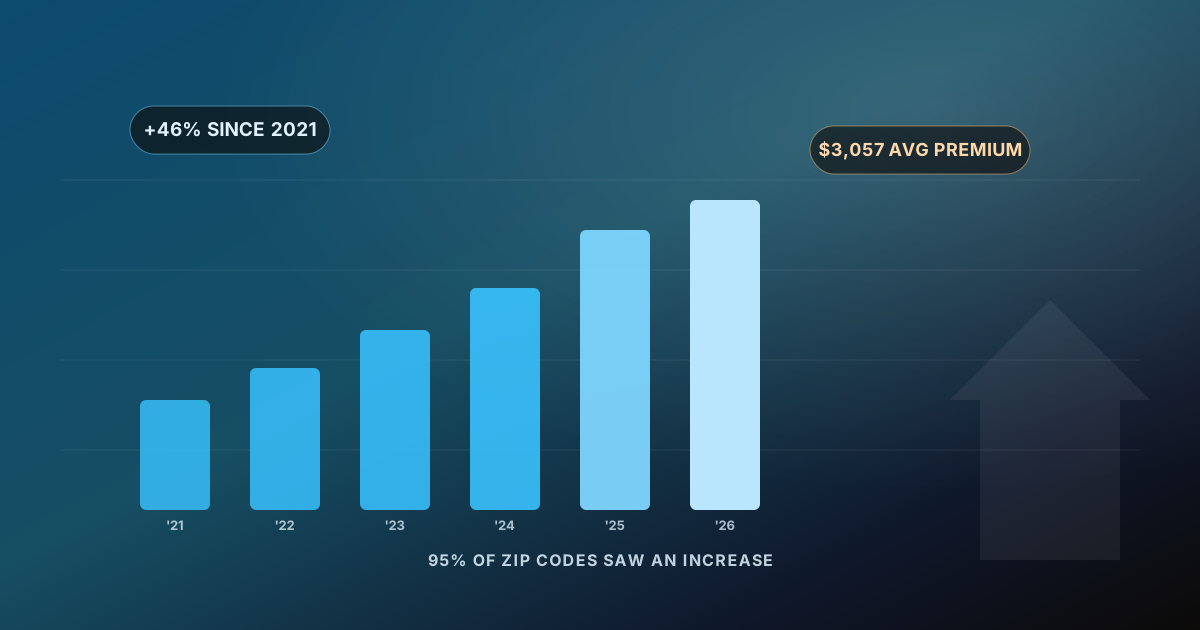
The 46% figure every insurance article repeats comes from a comparison marketplace's quote data. The government's own price index says household insurance rose 16% since 2021 — below headline inflation. Motor vehicle insurance rose 51.4%.
Sujit Karki
|||10 min read
#home insurance#auto insurance#insurance rates 2026#deductible#CPI#Original Data
Frequently Asked Questions
That figure comes from Insurify, an insurance comparison marketplace reporting the average premium quoted through its own funnel. The BLS Consumer Price Index, which prices a constant policy rather than averaging whatever coverage people bought, shows tenants' and household insurance up 16.0% from the 2021 annual average to July 2026 — below headline inflation of 23.2% over the same window. Both numbers can be correct because they measure different things, but only one of them is a price index, and almost nobody quoting the 46% says which they are using.
Get new posts in your inbox
No spam, unsubscribe anytime.
About the Author
Sujit KarkiFinance Researcher & Market Analyst
Independent finance researcher and market analyst with expertise in macroeconomics, equity markets, and personal finance. I help regular investors make better-informed decisions through rigorous, data-driven analysis.
The widely-quoted 46% home-insurance increase comes from a comparison marketplace's quote data, not a price index
BLS CPI puts tenants' and household insurance up 16.0% from the 2021 average to July 2026 — below headline inflation of 23.2%
Motor vehicle insurance rose 51.4% over the same window, about 2.2x the headline rate — the real outlier
Household insurance was essentially flat in 2022 (index 99.9 vs 100) while headline inflation ran 8%
Both measures can be right: CPI prices constant coverage, marketplace averages also move when dwelling coverage amounts rise
A friend called me in June about a homeowners renewal that jumped $900 in a year — no claims, no changes to the house. She wanted to know whether her insurer was ripping her off. Answering that meant looking up what insurance prices had actually done, and every article I found repeated the same number: up 46% since 2021.
I went looking for where that number comes from. It comes from Insurify, a comparison marketplace, reporting the average premium quoted through its own funnel. That is a real measurement of a real thing. It is not a price index, and the government publishes one for the same goods.
Those two measurements disagree by thirty percentage points.
Two numbers, thirty points apart
Marketplace figure, home premiums since 20210%Insurify 2026 Home Insurance Rate Report
CPI, tenants' and household insurance0%2021 annual average to July 2026, BLS series SEHD
CPI, motor vehicle insurance0%Same window, BLS series SETE — 2.2x headline inflation
The Bureau of Labor Statistics publishes a monthly price index for insurance, on exactly the same basis as the headline inflation rate it reports every month. Measured from the 2021 annual average to July 2026, the latest month published:
BLS series
Item
Change
vs headline
SETE
Motor vehicle insurance
+51.4%
2.22x
SA0
All items (headline)
+23.2%
1.00x
SEHD
Tenants' and household insurance
+16.0%
0.69x
The item names are BLS's own, taken verbatim from its cu.item reference file rather than paraphrased, because the paraphrase is where this goes wrong. "Tenants' and household insurance" is not a synonym for "homeowners premiums", and treating it as one is the mistake worth not making.
Rebased so 2021 = 100, the three series separate almost immediately:
The detail that most surprised me is 2022. Household insurance sat at 99.9 — fractionally below its 2021 level — in the year headline inflation ran 8%. Whatever was happening to homeowners' bills that year, the constant-coverage price of household insurance was not part of it.
Auto is the actual outlier
The category with an unambiguous, price-index-confirmed increase far above inflation is the one usually written up as the calmer half of the story. Motor vehicle insurance is up 51.4% against a headline 23.2% — it rose 2.2 times as fast as everything else, and unlike the home figure this does not depend on which source you pick or how coverage amounts moved.
It also has not stopped in the way "stabilizing" implies. The index does flatten late — 158.0 in 2025 against 156.0 for the seven months of 2026 published so far — but that is a plateau at a level half again above 2021, not a return toward it. A driver whose premium stopped climbing in 2026 is still paying roughly 50% more than they were five years ago.
Why the two measures disagree
Neither number is wrong. They answer different questions, and the difference is not a technicality.
CPI holds coverage constant. A price index asks what the same thing costs this month versus last. If your policy is identical in every respect, CPI measures the change in its price and nothing else.
Your renewal does not hold coverage constant. If the estimated cost to rebuild your house rose — and construction costs did rise sharply — your dwelling coverage rose with it. You are buying more insurance than you were in 2021. That is a real increase in what leaves your bank account, and CPI is specifically designed not to count it as inflation, the same way a bigger car is not counted as a more expensive car.
A marketplace average also moves with who is asking. Insurify's figure is the average premium quoted through Insurify. If the mix of people shopping there shifts toward higher-value homes or higher-risk states, the average moves without any individual's price changing.
There is one more constraint worth stating plainly, because it limits my own number as much as theirs: tenants' and household insurance is 0.292% of the CPI basket as of December 2025, per BLS's own relative-importance table. It is a small, thinly weighted component, and it is not built to serve as a homeowners-premium tracker. I am not claiming CPI proves the 46% false. I am claiming that the number every article repeats has a methodology nobody states, that a differently-constructed official measure of the same goods lands thirty points away, and that you should know which one you are being handed.
What this does not mean
It does not mean your bill did not go up. Broad, real increases are well documented from sources with no marketplace incentive: the Consumer Federation of America, using its own methodology, found 95% of US ZIP codes saw a premium increase between 2021 and 2024, with the average policy rising $648 to $3,303. In a March 2026 Pew survey of 3,524 US adults, 71% said their homeowners costs had risen and 42% said they rose "a lot."
It does not mean the marketplace figures are dishonest. They measure quoted premiums, which is a legitimate and arguably more decision-relevant quantity than a constant-quality index. The problem is the reporting layer, where a marketplace average gets repeated as though it were an inflation statistic.
It does not mean CPI is the better number for you personally. If your rebuild cost rose 30%, CPI's 16% describes a policy you no longer own.
Non-renewals are the quiet part of this story
None of the above touches the harder problem: in the worst-hit markets, insurers are leaving entirely. Florida non-renewals surged 280% between 2018 and 2023 (Brookings), and State Farm stopped writing new homeowners policies in California in 2023. If your insurer drops you, it is frequently not personal — it is a market-wide retreat from a geography or risk type, and no amount of shopping around fixes it.
Why Your Premium Keeps Climbing
Three forces, stacked on top of each other:
Climate losses are more frequent and more expensive. Wildfire, hurricane, and severe convective storm (hail, tornado) losses have grown both in frequency and in dollar severity over the past several years. Insurers price to the losses they actually expect to pay, and those expectations have risen sharply.
Rebuilding a home costs more than it used to. Materials and skilled-labor costs for construction haven't come back down to pre-2021 levels, so even a home with an unchanged risk profile costs more to fully replace after a covered loss — and premiums are priced against replacement cost, not the home's market value. This is also the single biggest reason a marketplace average outruns a constant-coverage price index.
Reinsurance got brutally expensive. Insurers buy their own insurance (reinsurance) to cover catastrophic, portfolio-wide losses. When reinsurance repriced sharply upward after several bad catastrophe years, that cost flowed straight through to what you pay at renewal — it's largely invisible to consumers but it's one of the biggest single line items behind the increases.
The Actual Ways to Fight a Rate Hike
Move
Typical savings
Effort
Best for
Shop around at every renewal
5-25%
Low — 20 minutes, a few quotes
Everyone, every single year
Bundle home + auto
10-25%
Low
Anyone with both policy types
Raise your deductible
10-35%
Low
Households with 3+ months of the extra deductible saved as an emergency fund
Add telematics / smart-home monitoring
5-15%
Medium
Safe drivers; homes with water-leak or smoke sensors already installed
Improve your credit (where legal)
Varies, can be large
High, slow
States that allow credit-based pricing (banned in CA, HI, MA)
Appeal the increase with documentation
Sometimes reverses the hike
Medium
When the increase looks like an error or outlier vs. your area
The single biggest lever is the most boring one: shop around every year, without exception. Insurers price aggressively for new customers and much less aggressively for renewals, betting that inertia keeps you from checking. That bet is usually correct — don't let it be correct on your policy.
Given the numbers above, the auto policy is where this is most worth your time. A category up 51% in five years is one where the spread between a loyal renewal and a fresh quote has had the most room to open up.
Should You Raise Your Deductible?
Raising your deductible is the fastest lever you fully control, but "it lowers your premium" isn't the same as "it's a good trade for you specifically." The real question is whether the annual savings, compounded over the years between claims, beats the extra amount you'll pay out of pocket the one time you do file.
Pros
Immediate, guaranteed premium reduction — no approval process or waiting period
Discourages filing small claims that can themselves trigger future rate increases
The savings compound every year you don't file — often paying for the higher deductible many times over
Cons
A real cost if you have a claim soon after raising it
Only makes sense if you have the extra deductible amount sitting in accessible savings
Doesn't address the underlying reasons rates are rising — it shifts risk to you, it doesn't remove it
Interactive · should you raise your deductible?
The deductible math nobody shows you
Current annual premium$3,057
Current deductible
Considering raising it to
You file a claim about once every8 yrs
Raising your deductible saves about $0/yr, but costs $1,500 more out of pocket per claim. Breakeven is about 3.3 years between claims — worth it at your claim frequency.
New annual premium at $2,500 deductible$2,605
Current premium at $1,000 deductible$3,057
Deductible-tier discounts are illustrative industry-typical ranges, not a quote — insurers price this differently by state, carrier, and claims history. Default premium ($3,057) is the Insurify 2026 national average home-insurance estimate. Get an actual quote before changing your policy.
Here's What I'd Actually Do
In order, if I were staring down a renewal notice:
Get two to three competing quotes before you do anything else. This alone resolves most "is this normal" anxiety — either your current insurer is roughly in line, or you have leverage to negotiate or switch.
Start with the auto policy. It's the category the price index says actually ran away, and the one where a stale renewal is most likely to be badly priced.
Call and ask specifically why the premium rose, and ask for every applicable discount — claims-free, multi-policy, security system, updated roof, paid-in-full. Insurers don't proactively apply every discount you qualify for.
Check whether your dwelling coverage moved. If your premium rose and your rebuild estimate rose with it, you are buying more coverage, not just paying more for the same coverage — and that is worth confirming is actually right for your house.
Raise your deductible only if you can genuinely absorb it. Run the calculator above with your real claim history — most people file a claim far less often than they assume, which usually tips the math toward raising it.
Bundle home and auto if you haven't already — it's close to a free 10-25% with almost no downside.
Series. Three CPI-U series, US city average, not seasonally adjusted — the same basis the headline rate is published on, so the comparison is like for like. CUUR0000SETE (motor vehicle insurance), CUUR0000SEHD (tenants' and household insurance), CUUR0000SA0 (all items). Item names are taken verbatim from BLS's cu.item reference file, not paraphrased.
Window. From the 2021 annual average — twelve monthly index values, the reading most consistent with how BLS reports annual change — to July 2026, the latest month published at the time of writing. "Since 2021" is ambiguous and the ambiguity is worth about two points, so the script also computes the change from January 2021 alone and publishes both: 55.2% for auto, 14.7% for household, 27.7% for headline. The ranking is unchanged either way.
The 2025 gap. October 2025 is absent from all three series, and motor vehicle insurance is also missing November 2025. Averaging each series over whatever months it happens to have would compare a ten-month mean against an eleven-month one and attribute the calendar difference to insurance. So each year in the chart is averaged over the months present in every series — ten months for 2025, seven for 2026 — and the script publishes which months it used. The 2026 point is a part-year and should not be read as a full-year figure.
Verification. The script refuses to report rather than guessing: it requires all twelve months of the 2021 base year before it will average them, requires every series to carry an observation at both ends of the window, and flags when series end in different months instead of silently truncating. Every check there is one it failed at least once while being written.
What is not measured. CPI prices constant coverage. It does not capture policyholders being moved to higher dwelling limits, being non-renewed, or leaving the private market for a state insurer of last resort. Those are the parts of this story a price index structurally cannot see.
Frequently Asked Questions
That is a comparison marketplace's average quoted premium. BLS CPI shows tenants' and household insurance up 16.0% over the same window, below headline inflation of 23.2%. Both measure real things; only one is a price index.
Warning
Educational content, not insurance advice. Deductible-tier discounts and savings ranges are illustrative industry-typical figures, not a quote from any specific insurer — actual pricing varies by carrier, state, and your individual risk profile. Get a real quote before changing your policy.

 Sujit Karki|||10 min read