
Key Takeaways
- June CPI fell 0.4% month-over-month — the biggest monthly drop since April 2020 — pulling annual inflation to 3.5% from 4.2%, but core CPI stayed flat at 2.6% year-over-year
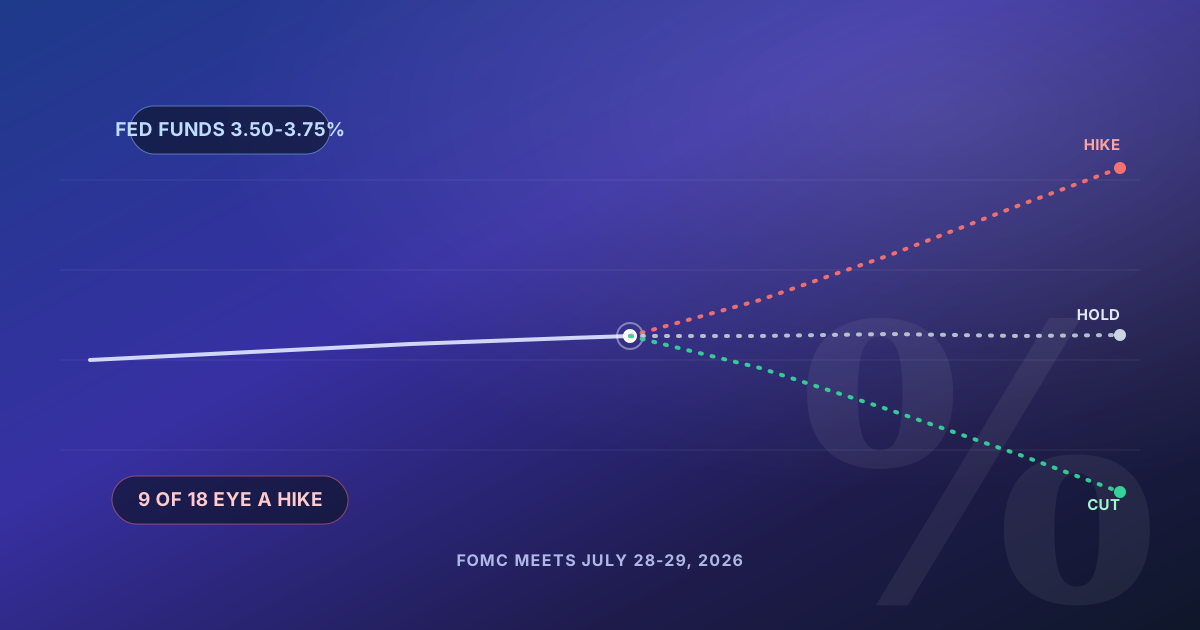
- The Fed held rates at 3.50–3.75% in June, and 9 of 18 officials now pencil in a hike for 2026, with the median dot rising to 3.8% from 3.4%
- September rate-cut odds sit around 51% as of July 16 (CME FedWatch), down from roughly 63% right after the CPI print — this is genuinely unresolved
- Top HYSAs pay 4.15–4.50% APY versus a 0.38% FDIC national average; the 30-year mortgage averages 6.55%, the highest since August 2025
- The July 28–29 FOMC meeting is the next real catalyst — lock in savings yields and mortgage rates now rather than betting on a cut that may not come
I've been staring at the same contradiction for a week: inflation just posted its best monthly reading since the pandemic, and the Federal Reserve is arguably closer to hiking than it's been all year.
That's not a typo. On July 14, the Bureau of Labor Statistics reported that headline CPI fell 0.4% in June — the sharpest one-month drop since April 2020 — bringing the annual rate down to 3.5% from May's 4.2%. Normally that's the kind of print that gets rate-cut champagne popped early. Instead, markets spent the following two days trimming the odds of a September cut. Something else is going on underneath the headline number, and if you have a savings account, a mortgage, or a bond fund, it's worth twenty minutes of your time.
Let me walk through why the Fed isn't just cutting rates into a good CPI print, what new Chair Kevin Warsh actually signaled last month, and — the part you're really here for — what a hike, a hold, or a surprise cut would do to your savings yield, your mortgage payment, and any bond funds you're holding.
The Whiplash, in One Week
Here's the timeline, compressed.
July 14: June CPI comes in soft. Headline at 3.5% annual, down a full 0.7 points from May. Markets initially cheer — this is the kind of disinflation that usually greenlights cuts.
July 15–16: Traders actually look at the core number. Core CPI, which excludes volatile food and energy prices, was flat month-over-month and still running at 2.6% year-over-year — nowhere near the Fed's 2% target. Meanwhile Fed officials continue to talk tough. September rate-cut odds, which had been running around 63% right after the print, slid to roughly 51% by July 16 on CME's FedWatch tool. In two days, a "sure thing" cut became a coin flip.
That whiplash is the whole story of 2026 monetary policy in miniature: every time the data softens, the Fed's rhetoric hardens right back, because there's a new sheriff in town who genuinely doesn't trust one good month.
Why the Fed Is Suddenly Talking Hikes
Kevin Warsh was sworn in as Fed Chair on May 22, and he did not waste time reintroducing hawkishness to a market that had spent most of 2025 pricing in cuts.
At the Sintra central-banking forum on July 1, Warsh said flatly that "prices are too high" — not exactly the language of someone about to cut. At the June 17 FOMC meeting, the committee held the federal funds rate at 3.50–3.75%, but the real news was in the dot plot: 9 of 18 participants penciled in a hike somewhere in their 2026 projections, and the median 2026 rate estimate jumped to 3.8% from 3.4% just a quarter earlier. The post-meeting statement also shrank to roughly 130 words and dropped the Fed's prior language hinting at future easing.
Read between the lines and the message is: we're not confident inflation is beaten, and we're not going to pretend otherwise just because gas prices fell for a month.
Headline CPI includes food and energy, which swing around for reasons that have nothing to do with the underlying economy — an oil price dip from de-escalating geopolitical tension, for instance. Core CPI is the Fed's preferred lens because it filters that noise out. A soft headline number with a flat core number is exactly the kind of print that makes a central bank suspicious rather than celebratory.
What Warsh Actually Did at the June Meeting
It's worth separating what happened from what people are assuming happened, because I've seen both overstated.
June 2026 FOMC meeting, in three lines
| What changed | Detail | What it signals |
|---|---|---|
| Fed funds rate | Held at 3.50–3.75% | No move yet — this is a wait-and-see stance, not a hike |
| Dot plot | 9 of 18 now pencil a hike; median 2026 estimate up to 3.8% from 3.4% | A meaningfully more hawkish committee than a quarter ago |
| Statement language | Shrunk to ~130 words; easing-bias language removed | Less forward guidance, more meeting-by-meeting flexibility |
| Next meeting | July 28–29, 2026 | The next real chance for a signal shift, before Sept 16–17 |
None of this means a hike is coming. It means a hike is now a live option in a way it simply wasn't in early 2026 — and markets are pricing that uncertainty into everything from Treasury yields to mortgage-backed securities.
What This Does to Your Savings Account
This is the part I want people to actually act on, because it's true regardless of what the Fed does next.
The FDIC national average savings rate is just 0.38% APY. Meanwhile, some of the best nationally available high-yield savings accounts are paying 4.15% to 4.50% APY — Forbright Bank has been quoted around 4.15% by both NerdWallet and Bankrate, with some outlets citing promotional offers as high as 4.50%. On $20,000 in savings, that's the difference between $76 a year and roughly $830–$900 a year in interest. That gap has nothing to do with whether the Fed hikes, holds, or cuts in September — it's just the cost of leaving money at a big bank that doesn't have to compete for your deposits.
If the Fed does hike, HYSA yields would likely drift a bit higher still. If it cuts, they'll drift lower — banks tend to pass Fed moves through to savers with a lag, in both directions. Either way, the free money is switching banks today, not timing the FOMC.
You don't need to predict the Fed to capture most of the benefit. Moving idle cash from a 0.38% account to a 4.15%+ HYSA is a decision you can make this afternoon, and it dwarfs the few tenths of a percentage point a single rate decision would add or subtract.
A 1-year CD is worth a look too if you want to lock a rate before any potential hike pushes it lower for new savers — or before a cut lowers what's on offer. Popular Direct has been quoted around 4.17% on a 1-year CD by Bankrate, with CIBC cited near 4.21% by CNBC. Locking a CD trades flexibility for rate certainty; a HYSA keeps the money liquid but the rate can float with the Fed.
What This Does to Your Mortgage
The other side of the ledger is less fun. The 30-year fixed mortgage averaged 6.55% for the week ending July 16, per Freddie Mac — the highest print since August 2025. The 10-year Treasury yield, which mortgage rates track closely, has been sitting around 4.5–4.6%, reflecting exactly the same hawkish repricing that hit rate-cut odds.
On a $400,000 mortgage, the gap between a 6.30% rate and a 6.80% rate — a plausible band around a ±25bp Fed surprise — works out to roughly $65 a month, or close to $23,000 over the life of a 30-year loan. That's not nothing, and it's exactly why "wait for the Fed to cut" is a riskier bet on the mortgage side than it sounds, given cut odds are sitting at a coin-flip.
Reasons to Lock Now
- September cut odds are ~51%, not a sure thing — waiting is a bet, not a plan
- Rates are already near the highest since August 2025; a hike would push them higher still
- You can typically still refinance later if rates do fall meaningfully
- Locking removes a variable from an already stressful home purchase or refi
Reasons to Wait
- If the Fed does cut in September and again later in 2026, waiting could save real money
- Rate locks often carry a cost or expiration window
- A weakening labor market could force the Fed's hand toward cuts faster than the dot plot suggests
I lean toward locking if you have a genuine near-term need to buy or refinance. "The Fed might cut" has been the consensus story for over a year now, and the goalposts keep moving. Don't let a maybe cost you a rate you can afford today.
The Case For — and Against — a Hike
Let's be honest about both sides, because I don't think either is obviously right.
The case for a hike (or at least, no cut for a while): Core inflation is still 2.6% above the Fed's 2% target with zero monthly progress in June. Warsh has been explicitly hawkish in public remarks. Nine of eighteen FOMC participants are already penciling in higher rates for 2026. And a Fed that just installed a new, credibility-focused chair has every incentive to look tough rather than risk a repeat of the 2021–22 "transitory inflation" mistake.
The case against: One soft headline CPI print, even with a firm core reading, is still disinflationary momentum in the direction the Fed wants. Rate hikes into a cooling headline number risk overtightening into a slowdown. And dot plots are notoriously unreliable forecasts of what a committee actually does two or three meetings out — they're a snapshot of sentiment, not a promise.
My honest take: I don't think a hike at the July 28–29 meeting is likely, but I no longer think it's the tail risk it seemed six months ago. The bigger practical point for your finances is that the range of outcomes has widened, and that argues for locking in the rates you can control — savings yields and mortgage rates — rather than waiting for clarity that might not arrive for months.
What I'd Actually Do Right Now
Cutting through my own hedging, here's where I land, in order:
- Move idle cash to a top HYSA today. This is true regardless of what the Fed does July 28–29, and it's the single highest-value five minutes of financial admin most people can do this month.
- If you're buying or refinancing soon, get quotes and consider locking. A coin-flip cut isn't worth gambling a mortgage rate on, especially with rates already at a nearly year-long high.
- Check your bond fund's duration before you panic (or celebrate) on FOMC day. A short-duration fund barely moves on a 25bp surprise; a long-duration fund moves a lot. Know which one you own.
- Re-read this after July 28–29. The meeting itself, plus the August jobs report and the next CPI print, will do more to settle the hike-or-hold question than anything I can tell you today.
Every figure in this post — CPI, FedWatch odds, HYSA rates, mortgage averages — is a snapshot from mid-July 2026. Rate-cut probabilities in particular can swing 10+ points on a single data release. Re-check current numbers before making a locking decision, and treat this as a framework for thinking, not a prediction of what the Fed will do on July 29.
Model Your Own Scenario
Rather than argue about what the Fed will do, it's more useful to know what each outcome would actually mean for your specific numbers. I built a small tool for that.
Interactive · July 28–29 FOMC scenario
What a hike, hold, or cut does to your money
Pick a scenario
HYSA @ 4.15%
$0annual interest, +$0 vs. today's 4.15%
Mortgage @ 6.55%
$0monthly payment (30-yr), +$0 vs. today's 6.55%
Core bond fund
+0.0%rough price move, ~6-yr duration fund
Illustrative only. HYSA and mortgage baselines reflect published mid-July 2026 rates (Forbright ~4.15% APY; Freddie Mac 30-yr average 6.55%). Bond-fund move uses a simplified duration approximation (%Δprice ≈ −duration × Δyield), ignoring convexity, credit spreads, and fees. Not a rate forecast.
Toggle between a hike, a hold, and a cut, plug in your own savings balance and mortgage size, and see the estimated effect on annual HYSA interest, monthly mortgage payment, and a rough bond-fund price move. It won't tell you what the Fed will do — nobody can — but it'll tell you exactly what's at stake for your own money under each scenario.
If you want the bigger-picture context on how the Fed's tools actually work, I covered that in Understanding Federal Reserve Policy. And if this rate environment has you rethinking your portfolio mix more broadly, my index fund investing guide and the tools page both have calculators that pair well with this one.
The Bottom Line
The Fed isn't cutting just because one CPI print looked good, and it might not cut at all in September — current odds sit around a coin flip. Whatever happens July 28–29, the moves you can make right now don't depend on guessing correctly: shop your savings yield up from the 0.38% national average, lock a mortgage rate if you have a near-term need rather than betting on a cut, and know your bond fund's duration before headlines make you do something rash.
Frequently Asked Questions
Sources & References
- 1.Consumer Price Index Summary, June 2026 — U.S. Bureau of Labor Statistics, Jul 14, 2026
- 2.Federal Open Market Committee Meeting Calendars and Statements — Federal Reserve
- 3.CME FedWatch Tool — CME Group
- 4.Primary Mortgage Market Survey — Freddie Mac
- 5.National Rates and Rate Caps — FDIC
This is educational content, not financial advice. I'm a researcher, not your advisor, and I don't know your full financial picture. Interest rates, APYs, and mortgage quotes change frequently — verify current figures with your bank or lender before acting. Consider talking to a licensed financial professional before making major borrowing or savings decisions. See the full disclaimer.