Credit Card Debt Hit a Record $1.277 Trillion — Here's the Math on Actually Getting Out
American credit card debt just set a record, the average balance is $6,519 at 21% APR, and nearly half of BNPL users paid late this year. Here's the real payoff math, avalanche vs. snowball, and a calculator that uses your own numbers.
Sujit Karki
|||11 min read
#credit card debt#BNPL#debt payoff#avalanche vs snowball#personal finance 2026#Original Data
Frequently Asked Questions
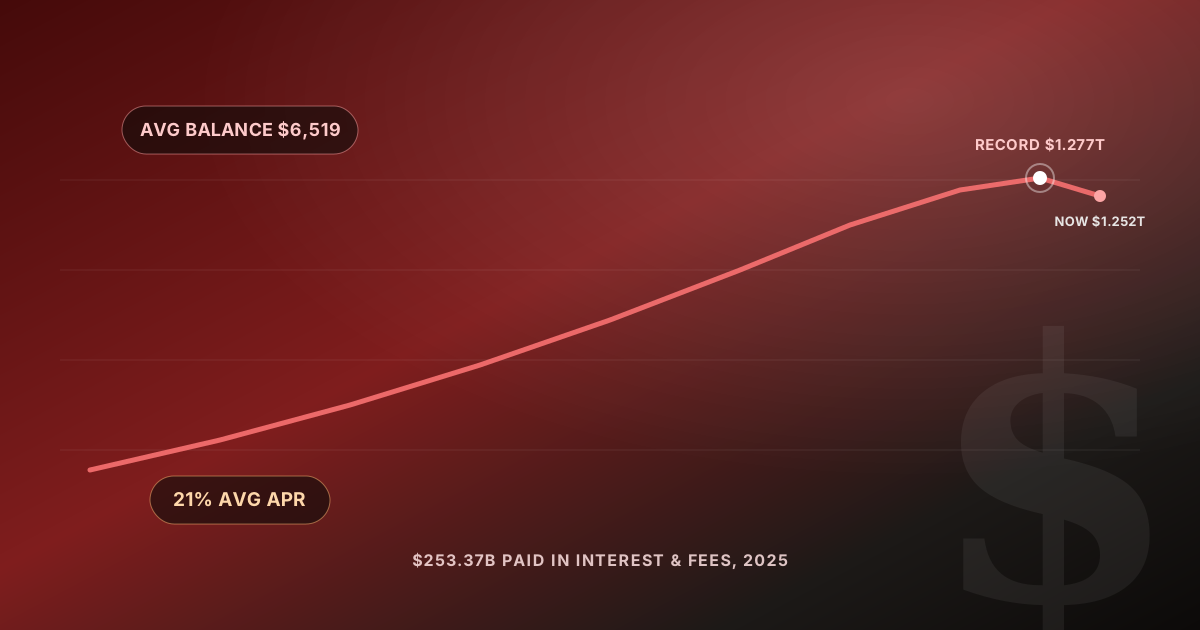
The average individual balance was $6,519 in Q1 2026, up 2.3% from a year earlier, according to LendingTree's analysis of New York Fed data. Total US credit card debt sits at $1.252 trillion, just off the all-time record of $1.277 trillion set in Q4 2025.
Get new posts in your inbox
No spam, unsubscribe anytime.
About the Author
Sujit KarkiFinance Researcher & Market Analyst
Independent finance researcher and market analyst with expertise in macroeconomics, equity markets, and personal finance. I help regular investors make better-informed decisions through rigorous, data-driven analysis.
The $1.277 trillion record is nominal — deflated with CPI, the real peak was Q4 2008 and households now owe about 7% less than that
Balances eased to $1.263 trillion in Q2 2026, the latest quarter the New York Fed has published
The average individual balance is $6,519 at roughly 21% APR — a number more relevant to your life than the trillion-dollar headline
Americans paid $253.37 billion in card interest and fees in 2025 alone, well above the decade average of $162.08 billion
47% of Buy Now, Pay Later users paid late at least once in the past year, and FICO now factors BNPL history into some credit scores
Making only the minimum payment on a typical balance can take 17 years and cost nearly double the original balance in interest
Every few months a headline like "credit card debt hits record $1.277 trillion" goes around, and every few months I get the same message from a reader: "Okay, but what does that mean for me?" Fair question. A trillion-dollar number is basically meaningless to a person staring at their own statement. So let's skip the macro headline and go straight to the number that actually matters, and then the math on getting out.
Total US card debt (Q1 2026)$0Billion — down slightly from the Q4 2025 record of $1.277T
Average balance per person$0Up 2.3% year over year
Average APR0%All accounts, Q1 2026 — new-card offers run closer to 23.8%
The Number That Should Actually Scare You
Total balances are a headline. $6,519 at 21% APR is a life. That's the average individual credit card balance as of Q1 2026, according to LendingTree's read of New York Fed household debt data, and it's up 2.3% from $6,371 a year earlier. The average APR sits right around 21% across all accounts — but if you've opened a card recently, your rate is probably closer to the average new-card offer, which is 23.79%.
Run that $6,519 balance at 21% and only pay the minimum, and you're not looking at a bill you'll shake off in a few months. You're looking at a multi-year financial commitment you didn't sign up for on purpose — nobody opens a credit card intending to carry it for a decade. It just happens one "I'll pay it off next month" at a time.
Zoom out for a second, because the trend matters too: total US card debt hit an all-time record of $1.277 trillion in Q4 2025 before easing to $1.263 trillion in Q2 2026, the latest quarter the New York Fed has published. Since the pandemic-era low of $770 billion in Q1 2021, total card debt is up more than 60%.
But that record is nominal, and the real one belongs to 2008
Every one of those headlines quotes a nominal figure. Over twenty years of inflation a nominal series sets records almost by construction, which makes the headline close to uninformative. So I parsed the New York Fed's published workbook directly and deflated the series with BLS CPI. The script is published, including the spreadsheet reader, since the Fed publishes this only as an .xlsx.
In constant 2026 Q2 dollars:
Quarter
Nominal
Real (2026 Q2 $)
2008 Q4
$0.866T
$1.358T
2012 Q4
$0.679T
$0.985T
2019 Q4
$0.927T
$1.204T
2021 Q4
$0.856T
$1.029T
2025 Q4
$1.277T
$1.316T
2026 Q2
$1.263T
$1.263T
The nominal record is 2025 Q4. The real record is 2008 Q4, and nothing since has come close to it. Measured in today's money, American households owe about $95 billion less on credit cards than they did at the 2008 peak — roughly 7% below it.
That does not make the debt harmless. It does mean the annual "record debt" headline is telling you about the value of the dollar at least as much as it is telling you about household borrowing. And there are two things pushing the real picture further in the reassuring direction: this is an aggregate, so a flat real total across a growing population is a falling real average per household; and the balance says nothing about the rate attached to it.
There is one thing pushing hard the other way, and it is the reason the next section exists. Buy-now-pay-later is largely invisible to this series. Most BNPL is not furnished to the credit bureaus the New York Fed builds this report from, so the measured total understates what households actually owe — by an amount this data structurally cannot show.
And the part I think gets buried under the "trillion dollar" framing: Americans paid $253.37 billion in credit card interest and fees in 2025 alone — well above the ten-year average of $162.08 billion (WalletHub, using FFIEC/Federal Reserve data). That's not debt. That's money gone, permanently, for the privilege of having carried a balance.
Why It's Gotten This Bad
I don't think this is a story about people suddenly getting worse with money. A few structural things are stacked against cardholders right now:
Rates never really came down. Even as the broader rate conversation shifted through 2025 and into 2026, card APRs stayed stubbornly high — 22.15% on accounts actually assessed interest as of Q2 2026 (Federal Reserve G.19). Cards have never repriced downward the way mortgages or savings accounts do; issuers are quick to raise rates and slow to cut them.
Delinquency is genuinely murky right now, and I want to be straight about that. You'll see the claim floating around that card delinquency "hit 13.1%, the highest in 16 years" — that figure is a serious (90+ day) delinquency share of balances from NY Fed data. But the Federal Reserve's broader measure of all-commercial-bank 30+ day delinquency was 2.92% in Q1 2026. These are two different rulers measuring two different things — one is the share of balances seriously behind, the other is the share of accounts mildly behind — and conflating them overstates the crisis in one direction or understates it in the other. The honest read: delinquency is elevated versus a few years ago, but the "worst in 16 years" framing needs the asterisk.
BNPL quietly became a shadow credit line. More on that below — but it's eating into the same wallets that already carry card debt, and it mostly doesn't show up in these headline numbers at all.
Why 'Average' Understates Your Own Situation
The $6,519 average includes people who pay their card off in full every month and carry $0 in interest-bearing debt. Among people who actually revolve a balance month to month, the real number is meaningfully higher. If your balance is above $6,519, you are not an outlier — you're closer to the median carrier, not the median cardholder.
The BNPL Problem Nobody Saw Coming
Buy Now, Pay Later felt like the polite alternative to credit cards for a while — no interest, four easy payments, no APR conversation. Then it quietly became its own debt problem.
BNPL volume hit roughly $70 billion in 2025 — still just about 1.1% of total card spending, per the Richmond Fed — so it's not dethroning credit cards. But the behavior around it is the concerning part: 47% of BNPL users paid late at least once in the past year, up from 41% in 2025 and 34% in 2024 (LendingTree/QuestionPro survey of over 2,000 US consumers, March 2026). I'll flag the caveat clearly: that's a self-reported survey number, while industry-reported delinquency on BNPL loans themselves is closer to the low single digits. Both things can be true — people miss payments more than issuers officially report as delinquent, often because they scramble to cover it a few days late.
Two changes make this worth taking seriously in 2026 specifically. First, FICO's Score 10 BNPL model, which started incorporating BNPL repayment history in fall 2025, means a habit of paying late on a "four payments of $37.50" plan can now follow you the way a missed credit card payment always has. Second, the CFPB rescinded its BNPL consumer-protection rule in May 2025 — the guardrails that would have applied credit-card-style dispute rights to these products are gone for now.
Where BNPL Is Fine
A single, planned purchase you can genuinely pay off in four cycles
0% interest if you actually hit every payment date
No hard credit pull for most 'pay in 4' products
Where BNPL Bites
Stacking multiple BNPL plans across different apps makes total owed hard to track
Late fees and, increasingly, credit-score hits if you miss a date
It doesn't feel like debt while you're taking it on — which is exactly the design risk
The Minimum-Payment Trap, in Real Numbers
Here's the part that should genuinely change how you think about "just paying the minimum." Take a balance close to the national average — say $6,715 — at 21% APR, paying only the minimum each month. Illustrative math based on CFPB minimum-payment disclosures puts that at roughly 17 years to pay off, and around $10,800 in total interest — more than the original balance itself.
The minimum payment isn't a plan. It's a formula your issuer calculated to keep you paying as long as legally allowed while collecting the maximum interest along the way. That's not a conspiracy theory — it's literally what the number is optimized for.
Avalanche vs. Snowball: Which Actually Wins
If you've got more than one balance, the order you attack them in matters more than people give it credit for.
Method
Order of attack
Best for
Downside
Avalanche
Highest APR first, regardless of balance size
Saving the most money — always wins on pure math
Slower first win if your highest-APR card also has the biggest balance
Snowball
Smallest balance first, regardless of APR
Staying motivated — quick wins build momentum
Can cost more in total interest if the small balance isn't the expensive one
Fidelity's own worked example shows avalanche saving on the order of $6,000 in interest versus snowball on an identical set of debts — but that gap depends entirely on your highest-rate debt also being a meaningfully sized one. If your smallest balance and your highest-APR balance are the same card, the two methods converge and the debate is moot. The honest takeaway: avalanche is the mathematically correct default, snowball is the behaviorally forgiving fallback, and either one beats the "pay whatever, whenever" non-plan most people are actually running.
Run Your Own Numbers
National averages are a starting point, not your answer. Drag in your real balance, APR, and monthly payment below, and see exactly how many months it takes and what it costs — plus what happens if you can find an extra $50 or $100 a month.
Interactive · run your own balance
How long is your card actually going to take?
Card balance$6,519
APR21.0%
Monthly payment$250
At $250/mo, you're debt-free in 36 months and pay about $2,263 in interest. Adding $50/mo saves about $507.
$250/mo — 36 months$0 interest
$300/mo — 28 months$0 interest
$350/mo — 23 months$0 interest
Standard amortization at a fixed payment, ignoring new charges, fees, or promotional rates. Defaults reflect the Q1 2026 average card balance ($6,519) and average APR (21.00%) — LendingTree/NY Fed and Federal Reserve G.19. Your card's actual minimum-payment formula may differ from a fixed dollar amount.
List every balance and its real APR — not the balance you remember, the one on this month's actual statement. You can't avalanche what you haven't written down.
Attack the highest-APR balance first, paying minimums on everything else. If you know yourself well enough to know you'll quit without an early win, snowball the smallest balance instead — a plan you'll actually finish beats a theoretically optimal one you abandon in month three.
Call and ask for a lower rate before you do anything dramatic. Issuers grant APR reductions more often than people expect, especially to customers with a decent payment history who simply ask. It costs you a phone call.
Stop opening new BNPL plans while you're carrying card debt. It's the same dollars, split across more apps, harder to track, and now potentially hitting your credit score too.
Automate whatever extra payment you can find, even $25. The calculator above shows how much a small, consistent bump actually saves — it's usually more than people expect.
If income is the real lever for you, my guide to starting a side hustle covers picking something and not messing up the taxes on it, and the 50/30/20 budget breakdown is the framework I'd use to find the extra payment in the first place. There are more free tools at /tools.
Frequently Asked Questions
The average individual balance was $6,519 in Q1 2026, up 2.3% year over year. Total US card debt is $1.252 trillion, just off the Q4 2025 record of $1.277 trillion.
Warning
Educational content, not financial or credit-counseling advice. Payoff math above uses standard amortization and illustrative assumptions; your card's actual minimum-payment formula, fees, and promotional terms may differ. If you're feeling overwhelmed by debt, a nonprofit credit counselor (NFCC.org) can review your actual accounts for free.
Methodology
Balances. Federal Reserve Bank of New York, Household Debt and Credit Report, quarterly, in trillions, taken from the "Page 3 Data" sheet of the published workbook. The Fed distributes this only as an .xlsx, so the script parses the file directly rather than transcribing figures by hand — the reader is dependency-free, walking the ZIP central directory and inflating the sheet XML with Node's built-in zlib. The composition table in this workbook begins at 2003 Q1.
Deflator. BLS CPI-U, US city average, not seasonally adjusted (CUUR0000SA0), averaged to quarters to match. October 2025 is missing from the published CPI series, so 2025 Q4 is averaged over two months rather than three; the script reports that rather than hiding it.
Verification. Two checks, either of which stops the run. The base quarter must deflate to itself exactly, and — since CPI rises across this whole period — every earlier quarter's real value must exceed its nominal value. A single quarter deflating downward would mean the CPI ratio had been applied upside down, which is the classic way to get this exact calculation backwards, so the script refuses rather than publishing a plausible-looking inversion.
Limits. Aggregate rather than per household, so a flat real total across a growing population is a falling real average — that cuts further against the headline, not toward it. CPI-U is a general deflator; there is no consumer-credit-specific price index and inventing one would be a stranger claim. Balances are outstanding amounts, not borrowing: a balance carried at 0% and one revolving at 24% count the same here. And BNPL is largely absent by construction.

 Sujit Karki|||11 min read