The July 2026 Student Loan Payment Shock: What RAP Actually Means for You
SAVE is dead and RAP is live as of July 1, 2026. It's real relief for low earners — and often a longer, costlier road for everyone else. Here's how to actually pick a plan before one gets picked for you.
RAP — the Repayment Assistance Plan — is the new income-driven repayment plan that took effect July 1, 2026 under the One Big Beautiful Bill Act (OBBBA). Monthly payments are set as a graduated 1–10% share of your adjusted gross income, reduced by $50 per dependent, with a $10 monthly floor. It forgives remaining balances after 30 years (360 qualifying payments), waives unpaid interest each month, and matches $50 toward your principal if your payment doesn't cover that month's interest.
Get new posts in your inbox
No spam, unsubscribe anytime.
About the Author
Sujit KarkiFinance Researcher & Market Analyst
Independent finance researcher and market analyst with expertise in macroeconomics, equity markets, and personal finance. I help regular investors make better-informed decisions through rigorous, data-driven analysis.
RAP (Repayment Assistance Plan) took effect July 1, 2026, replacing SAVE as the government's flagship income-driven plan under OBBBA
RAP charges 1–10% of your AGI, minus $50 per dependent, with a $10/month floor, a 30-year (360-payment) forgiveness clock, and a monthly $50 principal match plus unpaid-interest waiver
Low earners and people with dependents often do better under RAP; many mid-to-high earners face a higher payment and a longer repayment timeline than they had before
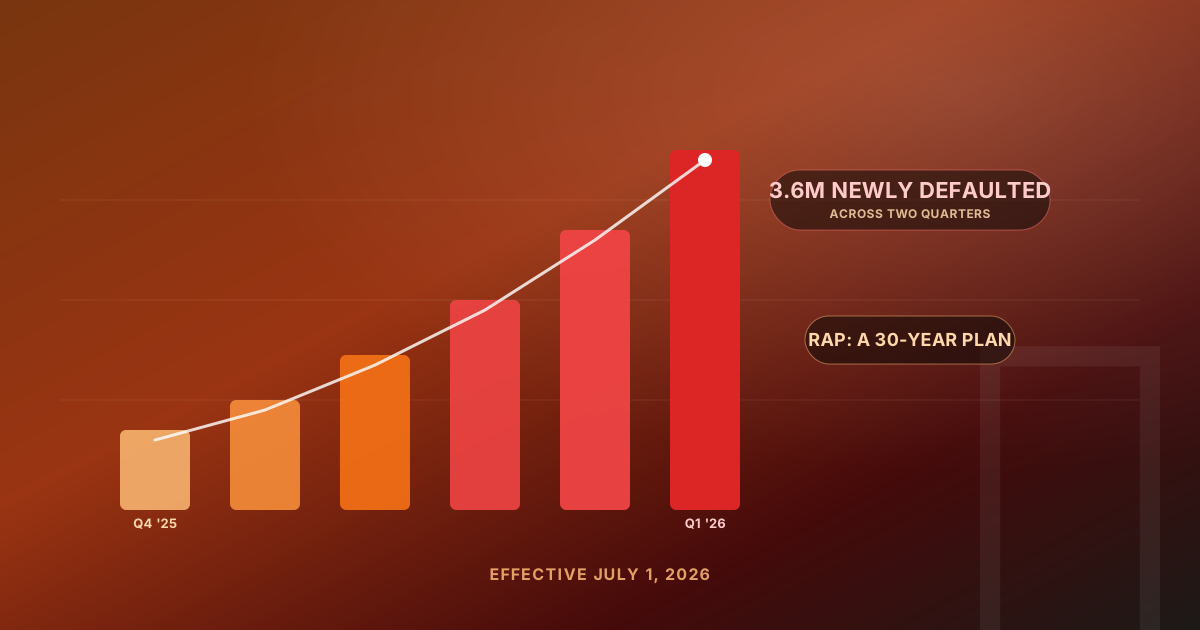
The NY Fed reports roughly 3.6 million borrowers newly defaulted across Q4 2025 and Q1 2026 combined, with average post-default credit scores falling 91 points
Grad PLUS loans are gone for new borrowers, Parent PLUS isn't RAP-eligible, and if you don't actively choose a plan, you can be defaulted into the Tiered Standard plan instead
If you have federal student loans and you did nothing this month, something changed anyway.
July 1, 2026 was the effective date for RAP — the Repayment Assistance Plan — the new income-driven repayment system created by the One Big Beautiful Bill Act (OBBBA), which President Trump signed back on July 4, 2025. SAVE, the plan that roughly eight million borrowers were parked on, is being wound down. If you haven't actively picked a new plan, you may already be sliding toward whatever your servicer defaults you into — and for a lot of people, that's not the plan that's cheapest for them.
I want to walk through what RAP actually does — not the marketing version, the math version — who genuinely comes out ahead, who doesn't, and why the default numbers right now are genuinely alarming. Then there's a calculator at the bottom so you can run your own numbers instead of trusting anyone's headline, including mine.
What Actually Changed on July 1
Three things happened at once, and they compound each other:
RAP became the primary income-driven plan for new and existing borrowers going forward, replacing SAVE.
SAVE entered a 90-day wind-down — borrowers on it are being transitioned to another available plan, typically RAP or the Tiered Standard plan, depending on servicer processing and borrower choice.
Grad PLUS loans were eliminated for new borrowers after July 1, 2026, and Parent PLUS loans remain ineligible for RAP — meaning parents who borrowed for their kids' education don't get access to the same income-based relief.
None of this happened quietly, but it also didn't get the airtime a change this size deserves. If you're on autopay and haven't logged into your servicer's portal since last year, this is the month to do it.
If You Don't Choose, One Gets Chosen for You
Borrowers transitioning off SAVE who don't actively select a new repayment plan risk being defaulted into the Tiered Standard plan, which is not income-driven and can carry a materially higher monthly payment than RAP or IBR would for the same income. Log into your servicer account and confirm which plan you're actually on.
How RAP Really Works
Here's the mechanism, stripped of jargon:
Your monthly payment is a graduated percentage of your adjusted gross income (AGI), scaling from 1% up to 10% as income rises.
You get a $50-per-month credit for each dependent, which lowers the payment for larger households.
There's a $10 monthly floor — nobody's payment drops to zero, even at very low income.
Any remaining balance is forgiven after 30 years — 360 qualifying payments, longer than the roughly 20–25-year clocks under legacy plans like IBR.
If your payment doesn't cover that month's accruing interest, the unpaid interest is waived — your balance won't grow from unpaid interest the way it could under some older plans.
The government also matches $50 toward your principal each month, which helps borrowers making the $10 minimum payment actually see their balance move.
The Department of Education's own example is a useful anchor: a single borrower with $35,000 in debt and $45,000 in income was paying $176/month under a prior IDR plan. Under RAP, that same borrower's estimated payment drops to $150/month, plus roughly $40 in interest waived and a $50 principal match — real, tangible relief in that specific case.
Why the $50 Principal Match Actually Matters
Under some older income-driven plans, a borrower whose payment didn't cover monthly interest would watch their balance grow every month, even while paying on time — a demoralizing dynamic that made "I'm paying but going backwards" a common complaint. RAP's structure — interest waiver plus a small guaranteed principal match — is specifically designed to prevent that. It's a meaningfully different design philosophy from SAVE or IBR.
Who Wins — and Who Loses — Under RAP
This is the part that gets flattened in headlines, so let's not flatten it.
RAP Tends to Help
Low-income borrowers, especially with the $10 floor and guaranteed principal progress
Borrowers with multiple dependents, thanks to the $50/dependent monthly credit
Anyone previously worried about negative amortization — the interest waiver stops balances from silently growing
Borrowers who value forgiveness certainty over speed — 30 years is a hard ceiling, not a moving target
RAP Tends to Hurt
Mid-to-high earners, whose payment is based on a percentage of full AGI rather than income above a poverty-line exclusion the way IBR works
Anyone hoping to be debt-free faster — RAP's 30-year clock is longer than IBR's roughly 20–25 years
Borrowers who would have paid off their balance early under a shorter plan — a longer amortization can mean more total interest even with lower monthly payments
Parent PLUS borrowers, who aren't RAP-eligible at all
My honest read: RAP is a genuine upgrade for the borrowers it was designed around — lower earners who need their payment to reflect what they can actually afford right now. It is not a blanket upgrade for everyone, and the "your payment might be lower" headlines skip over the fact that a lower monthly number stretched across a longer term isn't automatically the better deal. Run the comparison for your specific numbers before assuming either direction.
The Default Crisis Nobody's Talking About
While all this was being implemented, the underlying delinquency and default numbers got genuinely ugly — and I don't think this has gotten proportionate coverage.
The Federal Reserve Bank of New York's Liberty Street Economics blog, in a May 12, 2026 post, reported that roughly 1 million borrowers newly defaulted in Q4 2025, followed by another 2.6 million in Q1 2026 — about 3.6 million newly defaulted borrowers across two quarters. For borrowers who defaulted, average credit scores (Equifax Risk Score 3.0) fell 91 points, from 567 to 476 — a brutal hit that ripples into auto loans, rent applications, and credit card approvals. Separately, 10.3% of all student loan balances were 90+ days delinquent as of Q1 2026.
The scale of the current default wave
Metric
Figure
Source
Newly defaulted, Q4 2025
~1.0 million
NY Fed, Liberty Street Economics
Newly defaulted, Q1 2026
~2.6 million
NY Fed, Liberty Street Economics
Avg. credit score drop after default
91 points (567 → 476)
NY Fed / Equifax Risk Score 3.0
Balances 90+ days delinquent, Q1 2026
10.3%
NY Fed
Delinquent + in default (Dept. of Ed)
2.97M delinquent, 9.57M in default
U.S. Department of Education
The Department of Education's own figures show 2.97 million delinquent borrowers plus 9.57 million already in default, with internal projections suggesting the total in default could reach roughly 12.54 million by the end of 2026. Zhang, an economist tracking this closely, put it starkly: a new borrower falls into default roughly every 9 seconds.
Why This Is Happening Now, Specifically
A lot of this wave traces back to collections and reporting resuming after a long post-pandemic pause, combined with borrowers who were on SAVE — which had litigation-related forbearance for much of its life — suddenly facing real payment obligations again, often without having budgeted for it. If you went years without a real student loan payment, RAP's return to active, income-linked billing is the moment to get ahead of it rather than let it become a default statistic.
What Happened to SAVE, ICR, and PAYE
Quick status check on the plans you might have heard of:
SAVE: Being wound down through a 90-day transition window. If you were on it, you're being moved to RAP or Tiered Standard — confirm which.
ICR and PAYE: Still technically available to existing borrowers, but scheduled to end July 1, 2028. If you're on one of these, it's worth planning your next move well before that date rather than waiting for another last-minute scramble.
IBR: Remains available and is the most useful direct comparison to RAP for most borrowers, since it's also income-driven but calculated differently (see the calculator below).
The Employer Benefit That Just Became Permanent
Buried under all the repayment-plan news is a genuinely good, low-drama change: Section 127 employer student loan assistance — up to $5,250 per year, tax-free to the employee — was made permanent under OBBBA, having previously been a temporary, expiring provision. Starting in 2027, that cap will be indexed for inflation, so it should grow over time rather than staying frozen.
If your employer offers this, it's genuinely free money against your balance that never touches your taxable income — worth asking your HR team about directly if you don't already know whether it's offered.
How to Actually Pick a Plan
Cutting through the noise, here's the sequence I'd actually follow:
Log into your loan servicer's account this week and confirm which plan you're currently enrolled in — don't assume you're still on SAVE, and don't assume you've been auto-enrolled in RAP correctly.
Run your numbers under RAP, IBR, and Standard using your real AGI and dependents — the calculator below does this in about ten seconds.
If you have Parent PLUS loans, treat them separately — RAP isn't an option there, so your existing consolidation and IDR options need a different conversation with your servicer.
If ICR or PAYE is your current plan, start planning your 2028 transition now rather than waiting for the next deadline scramble — that pattern has clearly hurt a lot of borrowers already this cycle.
Ask HR whether your employer offers the $5,250 student loan benefit. If so, that's a standing request worth making regardless of which repayment plan you're on.
If self-employment income factors into your AGI and your repayment math, my side hustle tax guide covers the quarterly-estimate mechanics that also affect how your AGI gets reported for repayment purposes.
Compare Your Own Numbers
Enough theory — see what these plans actually mean for your situation.
Interactive · RAP vs. IBR vs. Standard
Which repayment plan actually costs you less?
Loan balance$35,000
Annual income (AGI)$45,000
Dependents0
RAP (30-yr)$0/mo
IBR (legacy IDR, ~20–25-yr)$0/mo
Standard (10-yr fixed)$0/mo
Simplified public estimate only — not your servicer's official calculation. RAP models the 1–10% AGI schedule as marginal $10k brackets, minus $50/month per dependent, with a $10/month floor; IBR approximates 10% of discretionary income above 150% of the poverty line; Standard assumes a 10-year fixed amortization at ~6.53%. Real IBR/Standard/RAP terms vary by loan type, filing status, and servicer — confirm your exact payment at studentaid.gov.
Plug in your balance, income, and number of dependents. It's a simplified public model, not your servicer's official number — but it'll give you a real sense of which plan direction is worth pursuing before you call your servicer to confirm the exact figure.
Frequently Asked Questions
RAP — the Repayment Assistance Plan — is the new income-driven repayment plan that took effect July 1, 2026 under the One Big Beautiful Bill Act (OBBBA). Monthly payments are set as a graduated 1–10% share of your adjusted gross income, reduced by $50 per dependent, with a $10 monthly floor. It forgives remaining balances after 30 years (360 qualifying payments), waives unpaid interest each month, and matches $50 toward your principal if your payment doesn't cover that month's interest.
The Bottom Line
RAP isn't a universal upgrade or a universal downgrade — it's a real, meaningfully different formula that helps some borrowers a lot and costs others a longer, sometimes pricier road. With millions of borrowers currently sliding into delinquency and default, the worst move available to you right now is inertia. Log in, confirm your plan, run your numbers, and make an active choice — because the alternative is having one made for you.
This is educational content, not financial or legal advice. Student loan repayment rules are complex and change frequently, and RAP's implementation details are still being finalized by servicers as of this writing. I'm a researcher, not your loan servicer — confirm your specific numbers at studentaid.gov or with your servicer before making a repayment decision. See the full disclaimer.

 Sujit Karki||8 min read