Your First Crypto 1099-DA Is Probably Wrong: What to Do Before You File
Brokers sent the first Form 1099-DA for 2025 crypto sales. It reports proceeds but often not cost basis — which can overstate your gain. Here's how to fix it.
No. You owe tax on your gain — proceeds minus cost basis. For 2025 the form often shows proceeds with $0 or 'unknown' basis, which overstates the gain if you don't correct it.
Get new posts in your inbox
No spam, unsubscribe anytime.
About the Author
Sujit KarkiFinance Researcher & Market Analyst
Independent finance researcher and market analyst with expertise in macroeconomics, equity markets, and personal finance. I help regular investors make better-informed decisions through rigorous, data-driven analysis.
Brokers issued the first Form 1099-DA in early 2026, covering 2025 crypto sales. For 2025 it reports GROSS PROCEEDS only — not cost basis.
If the form shows $0 or 'unknown' basis, it can make the IRS think your entire sale was profit. You correct this on Form 8949 using your own records.
Cost-basis reporting begins for transactions on or after January 1, 2026 — so the first forms with basis arrive in early 2027.
Since January 1, 2025, you must use wallet-by-wallet accounting (Rev. Proc. 2024-28). The old universal pooling method is gone.
You still owe tax on transactions that never appear on a 1099-DA — DeFi, self-custody, staking, airdrops.
If you sold, swapped, or spent crypto through a U.S. exchange in 2025, you probably received a new tax form early this year: the 1099-DA. It's the crypto cousin of the 1099-B that stock brokers have sent for decades, created by the 2021 infrastructure law. And I want to be blunt about the most important thing: for the 2025 tax year, that form is often incomplete in a way that can cost you real money if you file straight from it.
What just landed in your inbox
The IRS finalized the digital-asset broker rules under IRC §6045 in July 2024. Custodial brokers — Coinbase, Kraken, Gemini, Robinhood, and others — began issuing Form 1099-DA in early 2026 for calendar-year 2025 transactions. The rollout is phased:
2026 tax year (transactions on/after Jan 1, 2026): brokers must also report cost basis for covered assets.
So the form you're holding for 2025 is mainly a flag to the IRS that you transacted in crypto. It is not a finished tax calculation.
Warning
The IRS gets a copy of every 1099-DA. If yours shows large proceeds and you don't report the sale, expect an automated notice. But if you report the proceeds without your cost basis, you may overpay — sometimes badly.
The missing-basis trap
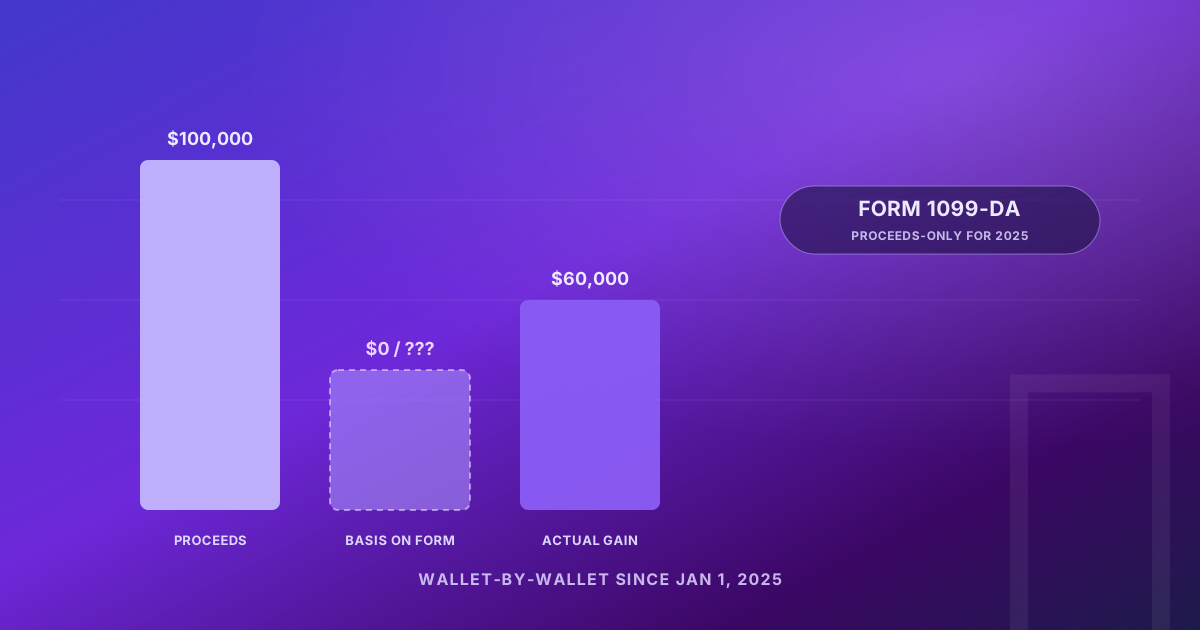
Here's the scenario that will bite thousands of people. Say you bought 1 BTC for $40,000 in 2023, held it in a hardware wallet, then moved it to an exchange and sold it in 2025 for $100,000. The exchange never saw your $40,000 purchase, so your 1099-DA shows $100,000 in proceeds and $0 — or "unknown" — cost basis.
Your actual taxable gain is $60,000. But if you or your software take the form at face value, the IRS sees $100,000 of gain. At a 15% long-term rate, that's the difference between roughly $9,000 and $15,000 of tax — $6,000 you don't owe.
Why wallet-by-wallet changed everything
The other shift most people missed happened January 1, 2025. Under Revenue Procedure 2024-28, the IRS made wallet-by-wallet (account-by-account) cost-basis tracking mandatory. The old "universal" method — pooling all your coins across every wallet into one queue — is no longer allowed.
Under the new rule, when you sell from a specific wallet, you can only use cost basis lots that sit in that same wallet. The default method is FIFO within each wallet unless you use specific identification. Rev. Proc. 2024-28 included a one-time safe harbor to allocate your pre-2025 basis across wallets, which had to be locked in by the earlier of your first 2025 disposal or your 2025 return's due date.
Note
If you moved coins between your own wallets, that transfer isn't a taxable sale — but it can break the basis trail your broker sees, which is exactly why the 1099-DA proceeds so often arrive without matching basis.
Three numbers that aren't the same
This is the crux, and it's where the honesty matters:
Number
What it is
Where it lives
Gross proceeds
What you sold for
Box on 1099-DA (reported for 2025)
Cost basis
What you paid, plus fees
Often missing for 2025 — you supply it
Taxable gain/loss
Proceeds minus basis
What you actually owe tax on
The 1099-DA reliably gives you the first number. For 2025 it frequently omits the second. You are responsible for the third. The reporting path is: 1099-DA → Form 8949 → Schedule D → Form 1040.
Interactive · check your own basis gap
How much would filing from a $0-basis 1099-DA cost you?
Gross proceeds (1099-DA)$100,000
Your actual cost basis$40,000
Your actual gain is $60,000. Filing from the form's $0 basis would tax you on all $100,000 — correcting it with your own records avoids overpaying by about $6,000.
Tax if filed from $0 basis
$0
Tax on actual gain
$0
Overpayment avoided
$0
Estimate only — not financial or tax advice.
Crypto basis gap — data table
Proceeds
$100,000
Cost basis
$40,000
Actual gain
$60,000
Rate applied
15%
Tax if $0 basis
$15,000
Tax on actual gain
$9,000
Estimate your basis gap
The estimator above shows the difference between the tax implied by proceeds-only reporting and the tax on your actual gain once you supply cost basis — so you can see what's at stake if you file straight from the form. It's an estimate, not tax advice.
Don't file from the 1099-DA alone. Treat it as one input, not the answer.
Reconcile it against your own records — every exchange, wallet, and transfer. Check for duplicate entries created by moving coins between your own wallets.
Fill in cost basis for every sale. If the form shows $0 or "unknown," use your purchase records or reputable crypto tax software to establish basis. Never let a $0 basis stand if you actually paid for the asset.
Confirm your accounting is wallet-by-wallet and that you documented a method. If you sold in 2025, the safe harbor window has already closed.
Report transactions that never appeared on any form — DeFi, self-custody, staking rewards, airdrops. The absence of a 1099-DA is not the absence of a tax obligation.
Keep records for at least three years, because the IRS will be matching these forms against returns.
Frequently Asked Questions
No. You owe tax on your gain — proceeds minus cost basis. For 2025 the form often shows proceeds with $0 or 'unknown' basis, which overstates the gain if you don't correct it.
This is educational content, not financial or tax advice. I'm a researcher, not your advisor, and I don't know your specific transaction history. Crypto tax rules are still evolving. Talk to a licensed tax professional before filing. See the full disclaimer.

 Sujit Karki||5 min read