Crypto Is Coming to 401(k)s — But It's Not There Yet, and That Distinction Matters
The Labor Department proposed a rule to open 401(k) plans to crypto and other alternative assets. Here's what's actually available today, what the rule really does, and whether digital assets belong in your retirement account.
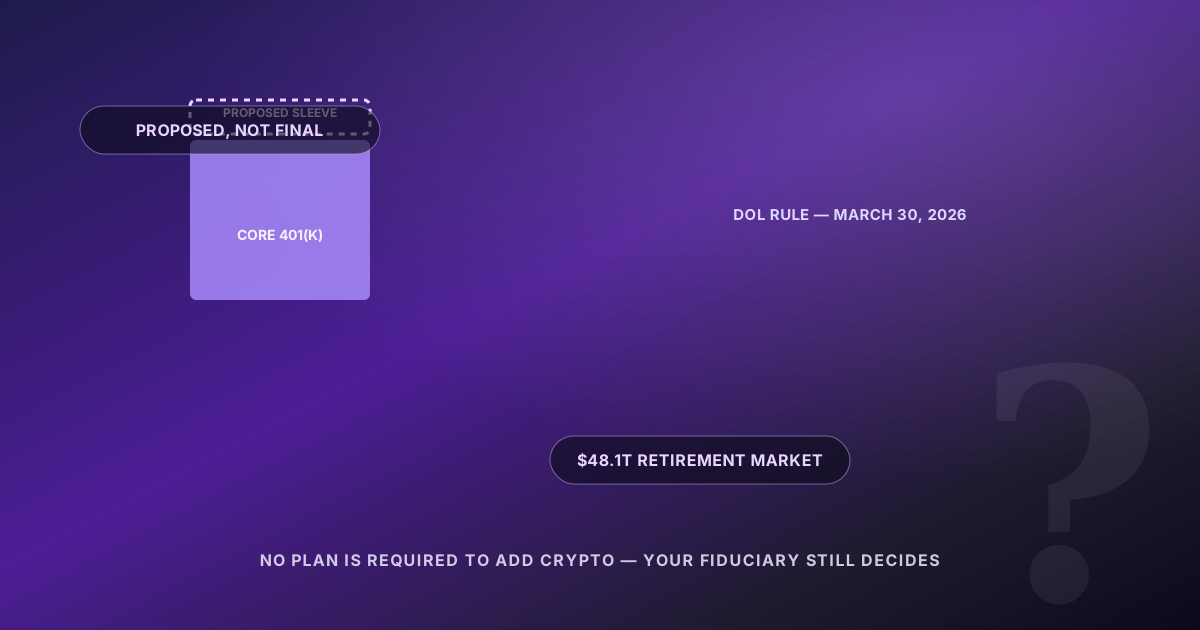
Only if your specific plan offers it, which very few do. The DOL rule is a proposal, not final as of July 2026, and even if finalized it wouldn't require any plan to add crypto — your employer's plan fiduciary still decides.
Get new posts in your inbox
No spam, unsubscribe anytime.
About the Author
Sujit KarkiFinance Researcher & Market Analyst
Independent finance researcher and market analyst with expertise in macroeconomics, equity markets, and personal finance. I help regular investors make better-informed decisions through rigorous, data-driven analysis.
Let me answer the question in the headline before we go anywhere: no, you almost certainly cannot buy Bitcoin in your 401(k) today, and the widely reported "crypto is coming to your 401(k)" story is a proposal that has not been finalized. That gap between the headline and the reality is the whole story, and if you get it wrong you'll either make a rushed decision or assume a protection exists that doesn't.
I've followed this regulatory thread from the executive order through the proposed rule, and here's the honest version.
Key Takeaways
The DOL rule was a PROPOSAL published March 30, 2026 — as of July 2026 it is not final.
Even if finalized, it would not require any plan to add crypto; your employer's fiduciary still decides.
Alternative assets were never legally banned from 401(k)s — the barrier was litigation risk, not statute.
The rule creates a process-based safe harbor, not an endorsement of crypto.
The US retirement market held $48.1 trillion as of Sept 30, 2025, so even a tiny allocation shift is enormous in dollar terms.
The headline vs. reality
On August 7, 2025, President Trump signed an executive order titled "Democratizing Access to Alternative Assets for 401(K) Investors," directing the Labor Department to reexamine fiduciary guidance around alternative assets — including digital assets, private equity, and real estate. On March 30, 2026, the DOL's Employee Benefits Security Administration published a proposed rule. The comment period closed June 1, 2026.
Regulatory timeline
How “crypto is coming to your 401(k)” actually got here
1
May 2025 — DOL rescinds "extreme care" guidance
Removes the Biden-era warning against crypto in 401(k)s
2
Aug 7, 2025 — Executive order signed
"Democratizing Access to Alternative Assets" directs DOL to act
3
Mar 30, 2026 — DOL proposes the rule
A process-based safe harbor, not a crypto endorsement
4
Jun 1, 2026 — Comment period closes
Warren, Sanders, and Scott send a 14-page objection letter
5
Today — Final rule: pending
Not law yet. No plan is required to add crypto even if it passes
Five steps, none of which is “crypto is now in your 401(k).” The rule is still a proposal as of July 2026.
A crucial nuance most coverage skips: alternative assets were never actually prohibited in 401(k)s. Under ERISA, plan fiduciaries have always had the authority to consider them. The real barrier was fear of lawsuits. In 2022 the Biden-era DOL told fiduciaries to exercise "extreme care" before adding crypto; the Trump DOL rescinded that guidance in May 2025, and the 2026 proposed rule goes further by offering procedural cover.
What the rule actually does
The proposed rule establishes a process-based safe harbor. If a plan fiduciary follows a documented evaluation process, their investment judgment is presumed reasonable and entitled to deference from courts. Notably, a fiduciary who runs the process and concludes crypto is not appropriate has met the standard just as much as one who adds it.
Note
"Crypto in a 401(k)" rarely means buying Bitcoin directly. More likely routes are a professionally managed asset-allocation fund with a small digital-asset sleeve, or a self-directed brokerage window. Each carries different fees, custody arrangements, and liquidity.
The scale is why Wall Street cares: the US retirement market held $48.1 trillion as of September 30, 2025 per the Investment Company Institute, and per ICI's Quarterly Retirement Market Data for the fourth quarter of 2025 (released March 26, 2026), Americans held $14.2 trillion in all employer-based defined-contribution plans on December 31, 2025, of which $10.1 trillion was in 401(k) plans. Even a 1% allocation shift is a tidal wave of capital.
The case for caution
I'm skeptical of hype, and this deserves some. Senator Elizabeth Warren blasted the proposal in a March 30, 2026 statement, saying: "As cracks emerge in the private credit market, private equity returns fall to 16-year lows, and crypto keeps tumbling, President Trump has decided now is the time to stick all of these risky assets into Americans' 401(k)s." She, Senator Bernie Sanders, and Representative Bobby Scott followed with a 14-page June 1, 2026 letter to Acting Labor Secretary Keith Sonderling calling the rule harmful to workers and counter to statute.
And the timing is awkward: as I've written in my 2026 Bitcoin macro analysis, Bitcoin traded near $64,811 in mid-July 2026 — after hitting a 21-month low of $58,190 on July 1, 2026, having started the year above $93,000 — and US spot Bitcoin ETFs bled about $4.5 billion in June 2026, their worst month since launching in January 2024, breaking the prior $3.56 billion record from February 2025. BlackRock's iShares Bitcoin Trust (IBIT) alone accounted for roughly $3.55 billion of that outflow, about 79% of the total.
Pros
Long time horizon can ride out volatility if allocation is small
Professional management and custody may beat DIY self-custody risk
Diversification argument if crypto is genuinely uncorrelated (debatable)
Cons
Retirement accounts have low tolerance for permanent loss near retirement
Fees on alternative-asset funds are often high and opaque
You can't harvest crypto tax losses inside a 401(k)
Volatility is extreme: Bitcoin fell about 50% from its peak
There's also a genuine measurement issue worth naming: comparisons of crypto's "returns" often cherry-pick start dates. A chart starting at a cycle low looks spectacular; one starting at the last peak looks catastrophic. Both are true and neither tells you what the next decade holds. For context on how a retirement account's tax structure should drive these decisions, my Roth IRA vs Traditional IRA guide is the better starting point than any coin.
Model a small crypto sleeve
This tool shows how a small crypto allocation changes a hypothetical portfolio's range of outcomes. It's deliberately blunt about downside.
Interactive · small-sleeve scenario model
What a small crypto sleeve does to your retirement number
Current portfolio value$100,000
Crypto allocation3%
Years to retirement20 yrs
Bull (+15%/yr crypto)$360,192
Flat (0%/yr crypto)$314,092
Bear (-60%/yr crypto)$311,092
Bull (+15%/yr crypto)
$0
Flat (0%/yr crypto)
$0
Bear (-60%/yr crypto)
$0
Flat-crypto scenario vs. a portfolio with 0% crypto
+$0
Hypothetical illustration only, not financial advice. Assumes a diversified core growing 6%/yr and a crypto sleeve held flat for the 20-year horizon; bull and bear cases apply +15%/yr and -60%/yr respectively for the same period. Returns are assumptions, not forecasts — actual crypto outcomes can be worse, including total loss.
Here's What I'd Actually Do
Do nothing based on the headline. The rule isn't final, and no plan is required to add crypto. There's no deadline pressuring you.
Fund the boring stuff first — employer match, then a diversified low-cost index core. Crypto is a satellite, never the core.
If you want exposure, cap it. Many advisors who allow it at all suggest keeping speculative assets to a low single-digit percentage of the total portfolio.
Read the fee disclosure on any alternative-asset fund your plan adds. High expense ratios quietly eat decades of compounding.
Watch for the final rule and, more importantly, watch whether your employer's plan actually adopts it. That's the only thing that changes your options.
Frequently Asked Questions
Only if your specific plan offers it, which very few do. The DOL rule is a proposal, not final as of July 2026, and even if finalized it wouldn't require any plan to add crypto.

 Sujit Karki|||4 min read