The $10,000 Car-Loan Interest Deduction Is Real — But It Probably Won't Save You $10,000
OBBBA's new above-the-line auto loan interest deduction runs through 2028. Here's who qualifies, the income phase-out, and what it's worth against record car prices.
No. It's an above-the-line-style deduction available even if you take the standard deduction. You still must report the vehicle's VIN on your return.
Get new posts in your inbox
No spam, unsubscribe anytime.
About the Author
Sujit KarkiFinance Researcher & Market Analyst
Independent finance researcher and market analyst with expertise in macroeconomics, equity markets, and personal finance. I help regular investors make better-informed decisions through rigorous, data-driven analysis.
OBBBA created a deduction of up to $10,000/year for interest on a qualifying new auto loan, for tax years 2025 through 2028.
You can claim it even without itemizing — but only for a NEW vehicle with U.S. final assembly, a loan originated after Dec 31, 2024, and the VIN reported on your return.
It phases out between $100,000–$150,000 MAGI (single) and $200,000–$250,000 (joint). Above the top line, you get nothing.
The $10,000 cap is the interest cap, not your tax savings. Most buyers pay far less than $10,000 in annual interest, so the real benefit is a few hundred dollars.
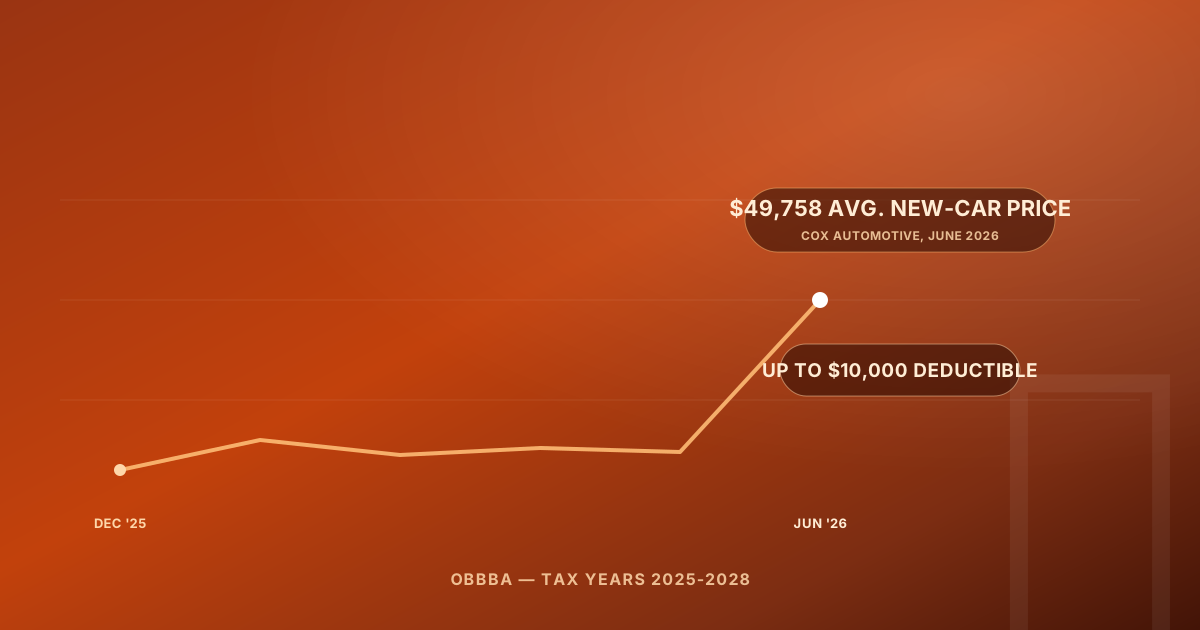
It arrives against a punishing backdrop: the average new-vehicle transaction price was $49,758 in June 2026, and auto-loan balances hit $1.69 trillion.
Of all the provisions in the One Big Beautiful Bill Act, the "no tax on car loan interest" line got some of the loudest headlines and, predictably, the most exaggeration. So let me do what I try to do with every shiny new tax break: figure out what it's actually worth to one real person buying one real car.
Short version: it's a genuine benefit, it's better than nothing, and it will not put $10,000 back in your pocket.
What the deduction actually is
The OBBBA, signed July 4, 2025, lets eligible taxpayers deduct up to $10,000 per year in interest paid on a qualifying auto loan. It's available for tax years 2025 through 2028. Crucially, it's structured so you can claim it even if you take the standard deduction — you don't need to itemize on Schedule A.
Your lender reports the interest you paid on a Form 1098-style information return, similar to how mortgage interest is reported.
Warning
The $10,000 is a cap on deductible interest, not a $10,000 credit and not $10,000 off your taxes. If you pay $3,000 of interest this year, your deduction is $3,000 — and the tax you save is that times your marginal rate.
Who qualifies (and who doesn't)
To claim it, all of these must be true:
The vehicle is new — original use begins with you. Used cars, even new-to-you, don't count.
Final assembly in the United States. Foreign brands with U.S. plants can qualify; check the VIN or window sticker.
The loan originated after December 31, 2024 and is secured by the vehicle.
The vehicle is for personal use (not fleet/commercial).
You report the VIN on your return each year you claim it.
The deduction then phases out by income. For every $1,000 (or fraction) your modified AGI exceeds $100,000 single / $200,000 joint, the deductible amount drops by $200 — hitting zero at $150,000 single / $250,000 joint. Note the $10,000 cap is the same regardless of filing status; there's no doubling for couples.
Pros
Available without itemizing
Covers foreign brands assembled in the U.S.
Stacks on top of the standard deduction
Reduces the real cost of financing a new car
Cons
New vehicles only — excludes the used market where most budget buyers shop
Leases don't qualify
Phases out at middle-to-upper incomes
Temporary: expires after tax year 2028
The headline $10,000 overstates the real benefit for most buyers
What it's actually worth
I ran the amortisation rather than estimating it. Take the average new vehicle at $49,758 (Cox Automotive, June 2026), put 20% down, and finance the remaining $39,806 over 72 months. First-year interest — the largest year, since interest falls as the balance amortises:
APR
Monthly payment
Year-1 interest
Share of the $10,000 cap
Worth at 22%
At 24%
4%
$623
$1,483
14.8%
$326
$356
6%
$660
$2,234
22.3%
$491
$536
7%
$679
$2,611
26.1%
$574
$627
9%
$718
$3,370
33.7%
$741
$809
11%
$758
$4,134
41.3%
$909
$992
At a realistic new-car rate the average buyer uses about a quarter of the cap and collects $574. Not nothing — but it is a tank of petrol a month, not the four figures the headline implies.
The loan you would need to actually reach $10,000
This is the number the coverage never puts a figure on. Solving for the principal whose first-year interest hits the cap:
APR
48 months
60 months
72 months
84 months
4%
$279,967
$272,892
$268,377
$265,247
7%
$159,010
$155,000
$152,447
$150,683
9%
$123,190
$120,091
$118,124
$116,768
11%
$100,408
$97,892
$96,299
$95,205
At a typical 7% you would need to borrow $152,447 on a new car with US final assembly. At 4% you would need $268,377. The cap is not a target most buyers fall short of — it is a threshold that requires financing a supercar, and the deduction is capped at $10,000 of interest precisely so that it never pays out at that level to anyone ordinary.
Then the phase-out takes some of it back
The remaining benefit erodes across the MAGI band. Same $39,806 loan at 7%, single filer:
MAGI
Deduction retained
Deductible interest
Worth at 22%
$100,000
100%
$2,611
$574
$110,000
80%
$2,089
$460
$125,000
50%
$1,306
$287
$140,000
20%
$522
$115
$150,000
0%
$0
$0
So the realistic range for a household buying an average new car is roughly $100 to $900 in year one, falling every year after. Take it — it is free and it is above the line, so you get it without itemising. Just do not let it move the decision about whether to buy the car.
The backdrop: record prices, rising delinquencies
The reason this deduction exists is that cars have gotten brutally expensive. According to Kelley Blue Book (Cox Automotive), the average new-vehicle transaction price was $49,758 in June 2026 — up 0.6% year over year and 0.4% from the upwardly revised May figure — after peaking at $50,609 in December 2025.
And borrowers are straining. The New York Fed's Q1 2026 Household Debt and Credit Report put total auto-loan balances at $1.69 trillion, with the flow into serious (90+ day) delinquency at 2.97%, roughly even with 2.94% a year earlier. A separate reading — the flow into early (30+ day) delinquency — was 7.72%, down slightly from 7.99%. Those two numbers measure different things (early versus serious), so don't treat them as interchangeable; the "record high" framing you'll see in some coverage refers to specific subprime cohorts, not the whole market.
Pro Tip
A tax deduction on interest does not make an unaffordable car affordable. If the payment doesn't fit your budget before the deduction, it doesn't fit after.
Interactive · run your own loan
What is the car-loan interest deduction actually worth to you?
Loan amount$40,000
APR7.0%
Loan term60 months
MAGI$90,000
Your first-year interest is about $2,581. After the $10,000 cap, you can deduct $2,581 — worth roughly $568 in actual tax savings.
First-year interest
$0
Deductible after phase-out
$0
Estimated tax saving
$0
Estimate only — not financial or tax advice.
Car loan interest deduction — data table
Loan terms
$40,000 @ 7.0% / 60mo
First-year interest
$2,581
Cap applied
$2,581
Phase-out reduction
$0
Deductible
$2,581
Tax saving
$568
Estimate your deduction
The calculator above estimates your first-year deductible interest and the resulting tax savings from your loan amount, rate, term, filing status, MAGI, and bracket — including the income phase-out. It's an estimate, not tax advice.
Before you fall in love with a model, check the VIN's final-assembly country. If it's not U.S.-assembled, the deduction is off the table no matter what.
Run your MAGI against the phase-out. If you're a single filer near $150,000 or a couple near $250,000, the benefit may be small or zero — don't let it drive the decision.
Don't buy more car because of the deduction. The tax savings are a rounding error next to a $50,000 sticker.
Keep every statement and the Form 1098 your lender sends — you'll need the interest figure and the VIN each year.
If you're shopping used, ignore this deduction entirely and focus on total cost of ownership instead.
Model whether a bigger down payment beats the deduction — cutting the loan cuts interest, which is guaranteed savings versus a temporary, capped tax break.
Frequently Asked Questions
No. It's an above-the-line-style deduction available even if you take the standard deduction. You still must report the vehicle's VIN on your return.
Methodology
Amortisation. Standard fixed-rate schedule: monthly payment P·r / (1 − (1+r)^−n), each month's interest is the outstanding balance times the monthly rate, and the first twelve are summed. First-year interest is the largest year, since interest falls as the balance amortises.
Sourcing, in two halves, because they differ. The $10,000 annual cap is stated directly in the IRS newsroom guidance cited below. The MAGI phase-out bands are an input carried from that same guidance package as reported by the sources below — this script does not derive them, and uscode.house.gov was unreachable when this was written, so the statute text itself was not read. The amortisation needs no source; it is arithmetic.
Verification. Three checks, any of which stops the run: the schedule must close (total payments equal principal plus interest, and the loan must retire), a 0% APR must produce exactly zero interest, and the phase-out must be continuous at both band edges.
Not modelled. Sales tax, registration, insurance and depreciation — all larger than the interest. State income tax, which this federal deduction does not reduce. And the assumption throughout is that the loan is outstanding for the full first year.
This is educational content, not financial or tax advice. I'm a researcher, not your advisor, and every loan and tax situation is different. Prices, delinquency data, and phase-out figures change. Talk to a licensed tax professional before making decisions about a car purchase or loan. See the full disclaimer.

 Sujit Karki|||8 min read