The Roth Catch-Up Rule Just Took Your Deduction: SECURE 2.0 in 2026
A new SECURE 2.0 rule forces high earners age 50+ to make 401(k) catch-up contributions as Roth. Here's exactly who it hits, the $150,000 wage test, and what to do.
No. It applies only to catch-up contributions in employer plans — 401(k), 403(b), and governmental 457(b). IRA contributions are unaffected.
Get new posts in your inbox
No spam, unsubscribe anytime.
About the Author
Sujit KarkiFinance Researcher & Market Analyst
Independent finance researcher and market analyst with expertise in macroeconomics, equity markets, and personal finance. I help regular investors make better-informed decisions through rigorous, data-driven analysis.
Starting January 1, 2026, if you are 50+ and earned more than $150,000 in FICA wages from your employer in 2025, any 401(k)/403(b)/457(b) catch-up contribution must be Roth (after-tax).
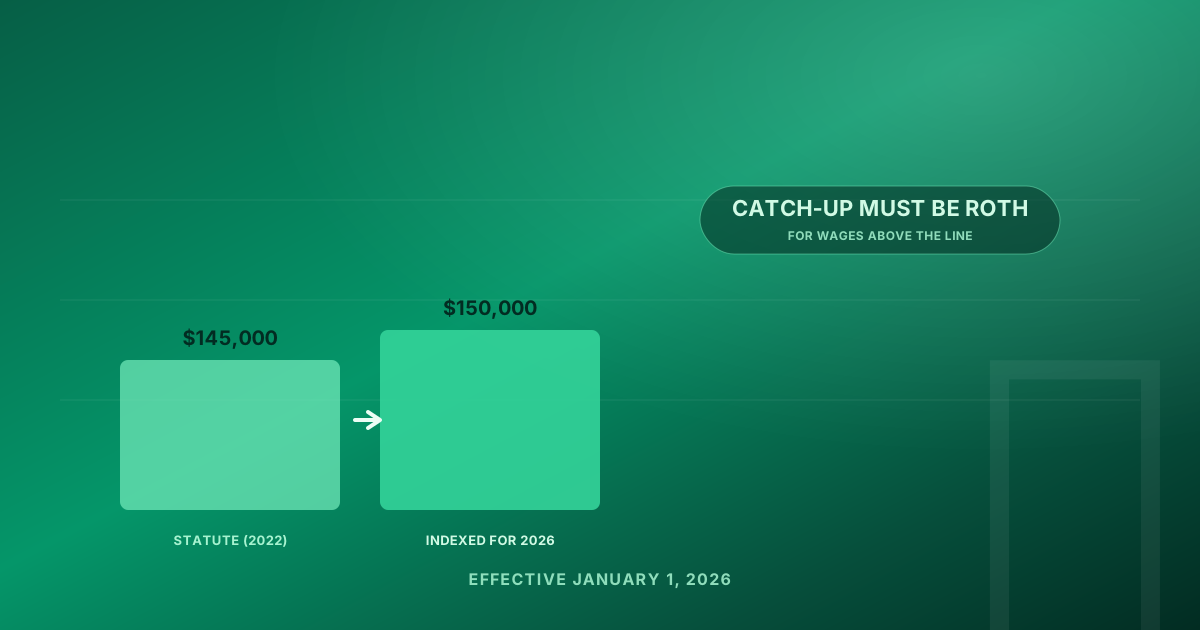
The threshold is $150,000 for 2026, not the $145,000 written in the law — the IRS indexed it up in Notice 2025-67 on November 13, 2025.
The test is FICA wages on your W-2, not adjusted gross income and not the $160,000 highly-compensated-employee line. Those are three different numbers.
You lose today's deduction on up to $8,000 (or $11,250 if you're 60–63), but you gain decades of tax-free growth. For most long-horizon savers that is a wash or a modest win.
The genuine danger is a plan with no Roth feature — that can wipe out your catch-up entirely until the employer amends the plan.
I've spent a lot of this blog telling people to max out pre-tax accounts when they can. So I want to be straight with you about a rule that quietly flips that advice for a specific group of people this year — and only for a slice of their contributions.
As of this year, a provision of the SECURE 2.0 Act of 2022 has finally taken effect: high earners aged 50 and older can no longer make catch-up contributions to a workplace retirement plan on a pre-tax basis. Those dollars must go in as Roth. The Treasury and IRS issued the final regulations on September 15, 2025, and the rule has applied since January 1, 2026.
Let me walk through who this actually touches, because the headlines are making it sound universal. It isn't.
What actually changed
Normally you get to choose whether your 401(k) contributions are pre-tax (deduct now, pay tax in retirement) or Roth (pay tax now, withdraw tax-free later). SECURE 2.0 removes that choice for one narrow population and one narrow bucket of money: catch-up contributions made by higher earners.
The mechanics for 2026:
The regular elective deferral limit is $24,500.
The catch-up limit for those 50+ is an additional $8,000.
For people who turn 60, 61, 62, or 63 during 2026, the "super catch-up" is $11,250.
If you're a high earner, that catch-up portion — the $8,000 or $11,250 — is where the new rule bites. Your first $24,500 can still be pre-tax if you want. Only the catch-up dollars are forced into Roth.
Note
This rule applies to 401(k), 403(b), and governmental 457(b) plans. It does not touch your IRA, your HSA, or the base $24,500 deferral. It's specifically about catch-up money for people over a wage line.
Who the rule actually hits
You are subject to the mandatory Roth catch-up in 2026 if all of these are true:
You are age 50 or older in 2026.
You want to make catch-up contributions at all (it's optional — if you don't do catch-up, none of this matters).
Your FICA wages from the employer sponsoring the plan were more than $150,000 in 2025.
That last number is the one everybody gets wrong, so let's dwell on it.
Three income numbers that are not the same
Here is where I have to flag something, because this is exactly the kind of place people misread their own situation. There are three different income figures floating around this topic, and they measure genuinely different things:
$150,000 in FICA wages — the threshold for the mandatory Roth catch-up. FICA wages are the Social Security/Medicare wages on your W-2, roughly Box 3/Box 5. Note that pre-tax 401(k) contributions still count as FICA wages, so deferring into your 401(k) does not lower this number.
$160,000 highly-compensated-employee (HCE) threshold — a different line used for nondiscrimination testing. Being an HCE is not what triggers the Roth catch-up rule.
Adjusted gross income (AGI) — what most people think of as "income." It's irrelevant to this rule.
The statute originally wrote $145,000. The IRS indexed it to $150,000 for 2026 in Notice 2025-67 on November 13, 2025. So if you read an older article citing $145,000, it isn't wrong — it's just out of date.
Income measure
2026 figure
What it decides here
FICA wages (prior year)
> $150,000
Whether your catch-up must be Roth
HCE threshold
$160,000
Nondiscrimination testing — not this rule
AGI
varies
Nothing for this rule
A practical wrinkle: the test is per-employer. If you changed jobs mid-2025 and earned under $150,000 with the plan's employer that year, you can be a very high lifetime earner and still not be caught in 2026.
The math: what you lose, what you gain
Losing the upfront deduction stings most in a high bracket. Say you're in the 32% federal bracket and you make an $8,000 catch-up. As pre-tax, that would have cut your current tax bill by $2,560. Forced into Roth, you pay that $2,560 now.
But that's not the whole story, and anyone who tells you this is purely a tax hike is being lazy. Roth dollars grow tax-free and come out tax-free. They also don't trigger required minimum distributions, and qualified Roth withdrawals don't push up your Medicare IRMAA surcharges or the taxation of your Social Security benefits.
Pro Tip
If you expect your tax rate in retirement to be similar to or higher than today's, Roth is often the better deal anyway. The people who genuinely lose are those who are certain they'll be in a much lower bracket in retirement.
Interactive · check your own exposure
Are you subject to the mandatory Roth catch-up in 2026?
Your age in 202655
2025 FICA wages (this employer)$160,000
Catch-up amount you plan to contribute$8,000
Standard 50+ catch-up limit: $8,000
Marginal federal tax bracket32%
At $160,000 in FICA wages, your catch-up is mandatory Roth. You'll pay about $2,560 upfront on $8,000 of catch-up contributions.
Subject to Roth catch-up?
Yes
Upfront tax on Roth catch-up
$0
Estimate only — not financial or tax advice.
Roth catch-up estimate — data table
2025 FICA wages
$160,000
2026 threshold
$150,000
Subject to rule
Yes
Catch-up amount
$8,000
Marginal bracket
32%
Upfront tax if Roth
$2,560
Estimate your exposure
The estimator above lets you plug in your age, prior-year FICA wages, catch-up amount, and marginal bracket to see (a) whether you're subject to the rule and (b) the upfront tax you'd pay on Roth versus pre-tax. It's an estimate, not tax advice.
Pull your 2025 W-2 and find your FICA (Social Security) wages. If they're at or below $150,000 with your plan's employer, you're not affected in 2026 — stop worrying.
If you're over the line, confirm your plan actually offers Roth. This is the real landmine. If it doesn't, your catch-up could be blocked entirely until the employer amends the plan (amendments are due by December 31, 2026).
Don't stop doing catch-up just because it's now Roth. Losing tax-free growth to avoid a Roth label is almost always the wrong trade.
Fund the base $24,500 pre-tax if you want the deduction. Only the catch-up is forced to Roth; the base deferral choice is still yours.
If you're self-employed with a solo 401(k) and only K-1/Schedule C income, ignore all of this — you have no FICA wages, so pre-tax catch-up remains available.
Revisit in November, when the IRS releases 2027 limits and the indexed threshold moves again.
Frequently Asked Questions
No. It applies only to catch-up contributions in employer plans — 401(k), 403(b), and governmental 457(b). IRA contributions are unaffected.
This is educational content, not financial or tax advice. I'm a researcher, not your advisor, and I don't know your plan's specific provisions or your tax situation. Rules and indexed thresholds change. Talk to your plan administrator or a licensed tax professional before making changes to your contributions. See the full disclaimer.

 Sujit Karki||6 min read