
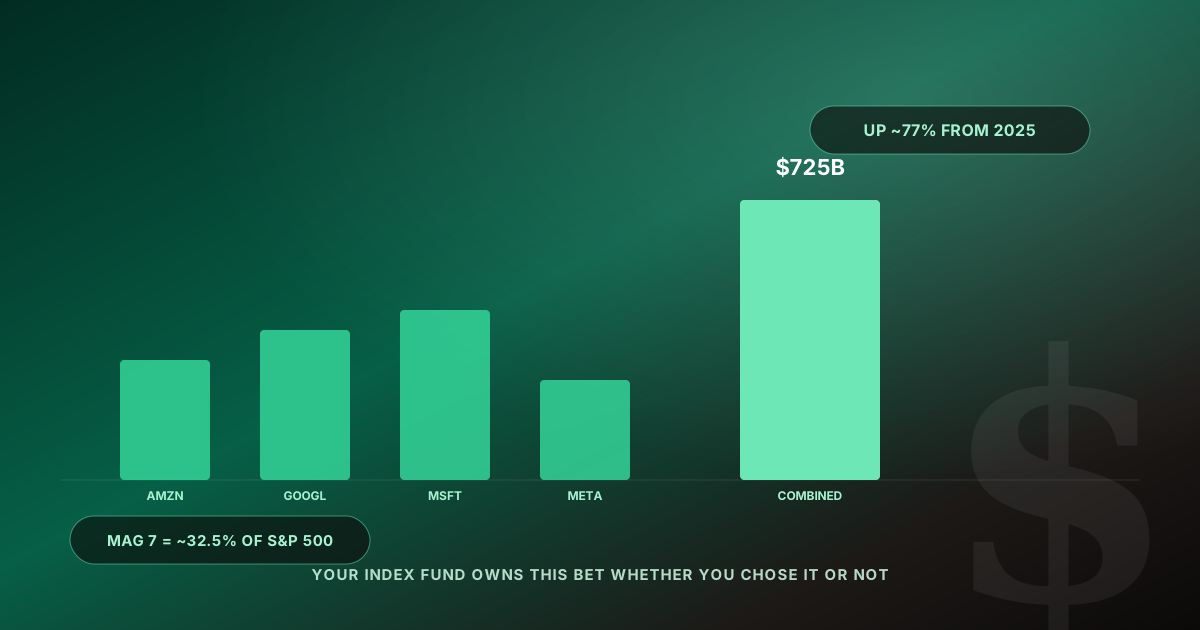
Here's the fact that should reframe how every index-fund owner thinks about 2026: four companies — Amazon, Alphabet, Microsoft, and Meta — collectively guided roughly $725 billion in capital expenditure this year, up about 77% from around $410 billion in 2025, and if you own an S&P 500 fund you are a co-signer on that bet whether you meant to be or not.
I own index funds. I recommend them. But "buy the index and forget it" quietly became "make a giant, concentrated wager on the AI buildout," and I don't think that swap was consented to by most of the people who made it.
Key Takeaways
- Amazon, Alphabet, Microsoft, and Meta guided roughly $725 billion in 2026 capex — up about 77% from ~$410 billion in 2025.
- Amazon alone projects ~$200 billion; the buildout is one of the largest single-year corporate investment cycles on record.
- The funding mix is shifting from cash flow to debt — Amazon raised at least $25 billion in a single July 2026 bond sale.
- The Magnificent Seven were about 32.5% of the S&P 500 in July 2026; the top 10 names ~38%.
- Goldman Sachs noted that $700 billion in 2026 capex would rival the peak dot-com investment boom as a share of GDP.
The number that reframes everything
The per-company guidance is striking: Amazon projecting roughly $200 billion, Alphabet $175–185 billion (later raised toward $190 billion), Microsoft tracking toward roughly $190 billion, and Meta $115–135 billion. Almost all of it flows into AI data centers, GPUs, custom silicon, and the power to run them.
Cash flow or debt?
This is the question that separates a healthy buildout from a fragile one, and the answer changed in 2026. For years the hyperscalers funded capex out of enormous operating cash flow. Now they're borrowing. Amazon returned to the investment-grade bond market in July 2026 to raise at least $25 billion, and its free cash flow is projected to turn negative this year. Bank of America research flagged that consensus estimates show AI capex reaching roughly 94% of operating cash flow (minus dividends and buybacks) in 2025 and 2026, up from 76% in 2024.
When capex is funded by cash flow, a bad year means slower growth. When it's funded by debt, a bad year means interest payments that don't care whether the AI revenue showed up on schedule. That's the difference that matters for the durability of these companies' earnings — and therefore your index returns.
Two honest caveats. First, debt isn't automatically bad; borrowing at reasonable rates to build productive assets is normal. Meta, for instance, carries a large debt load but also holds substantial cash. Second, the bull case is real: Google Cloud's contract backlog reached $460 billion, roughly double the $240 billion reported at the end of Q4 2025 — that's genuine booked demand, not a hope. But the bear case — "dot-com levels of spending on returns that haven't fully arrived" — is also real, and pretending otherwise is how people get hurt.
Why this is your problem
The Magnificent Seven accounted for about 32.5% of the S&P 500 in July 2026, and the top 10 companies roughly 38% — a concentration that, by some measures, exceeds the dot-com-era leaders. I covered the structure of this in the tech concentration crisis of 2026, and the AI capex story is the engine underneath it.
The practical consequence: your "diversified" index fund behaves more like a concentrated tech bet than the 500-company basket you picture. If the AI capex thesis pays off, that concentration supercharges your returns. If it disappoints, the same concentration works against you on the way down. An equal-weight S&P 500 fund cuts the Magnificent Seven's combined influence from roughly a third of the portfolio to around 1.4%. For how the Fed's "higher-for-longer" stance raises the cost of all this borrowing, see understanding Federal Reserve policy.
See your real AI exposure
Enter your equity portfolio value and this estimates how much of your money effectively rides on the Magnificent Seven under a cap-weighted index versus an equal-weight approach.
Interactive · what your index fund actually owns
Your real Magnificent Seven exposure
Default 32.5% reflects the cap-weighted S&P 500 in July 2026 — check your fund's actual weight for a precise figure.
Extra Mag 7 dollars from cap-weighting alone
$0Estimate for illustration, not financial advice. Actual fund weights vary by index and change daily.
Here's What I'd Actually Do
- Measure your exposure before judging it. Add up every account. If you hold multiple S&P 500 funds plus a tech fund, your true Magnificent Seven weight may be well above the ~32.5% index figure.
- Decide if the bet fits you — not whether it's "good." A 30-year-old accumulating can tolerate concentration a 63-year-old near retirement cannot.
- Consider an equal-weight or ex-mega-cap sleeve if you want index exposure without a one-third bet on seven names. It's a dial, not a switch.
- Watch the funding mix, not just the spending. Rising debt issuance and falling free cash flow are the signals to track in each earnings season, not the headline capex number.
- Don't panic-sell a diversified core. The move here is calibration, not exit.
Frequently Asked Questions
Sources & References
- 1.Tech AI spending approaches $700 billion in 2026, cash taking big hit — CNBC, 2026-02-06
- 2.Amazon raising at least $25 billion in bond sale — CNBC, 2026-07-07
- 3.Bond Issuance Backing AI Investment Tops $250 Billion — Morningstar, 2026-07
- 4.The Magnificent Seven's Market Cap vs. the S&P 500 — The Motley Fool, 2026-07
- 5.The Magnificent Seven's Effect on the S&P 500 — J.P. Morgan / Chase, 2026-07