7 AI Side Hustles That Actually Pay in 2026 (Real Numbers, Not Hype)
AI freelance work is genuinely paying more this year — freelancers doing AI work earn 34% more per hour. But the median isn't the thumbnail number. Here's the honest math on 7 real AI side hustles.
Yes, but the realistic numbers are far below the thumbnail claims. Upwork's Future Workforce Index 2026 found freelancers doing AI-related work earn 34% more per hour than those who don't, and freelancers doing complex AI work saw earnings grow 45% year-over-year in Q1 2026. Full-time skilled freelancers report a median of $85,000 annually; side freelancers median around $40,000. Beginners typically see $500–1,000/month in their first six months — a real but modest number, not the '$300/day' claims common in ads.
Get new posts in your inbox
No spam, unsubscribe anytime.
About the Author
Sujit KarkiFinance Researcher & Market Analyst
Independent finance researcher and market analyst with expertise in macroeconomics, equity markets, and personal finance. I help regular investors make better-informed decisions through rigorous, data-driven analysis.
Freelancers doing AI-related work earn 34% more per hour than those who don't, and complex AI work saw 45% year-over-year earnings growth in Q1 2026 (Upwork Future Workforce Index)
AI-application skills grew 109% year-over-year on Upwork, with AI video work up 329% and AI integration work up 178%
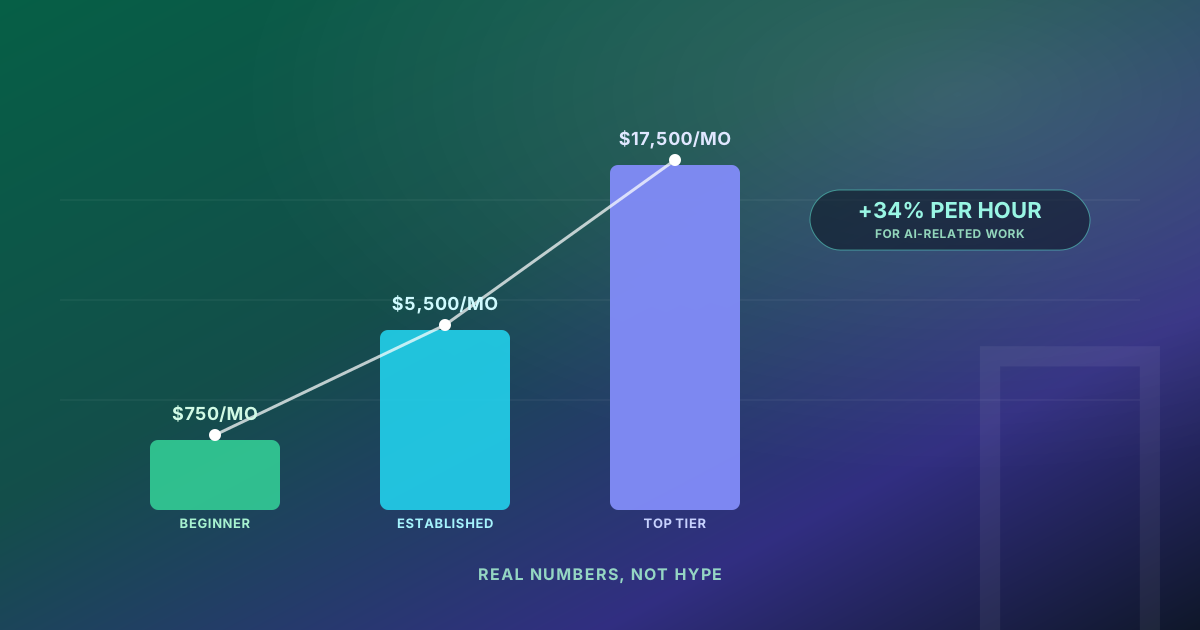
Realistic earnings run on a ladder: $500-1,000/month for beginners in the first six months, $3,000-8,000/month for established niche freelancers, $10,000-25,000/month for the top tier
Marketplace rules vary sharply — Adobe Stock allows disclosed AI content, Shutterstock only allows its own AI generator's output, and Getty bans AI content entirely
The FTC's Operation AI Comply has already banned or fined operators behind schemes worth $14 million to $25 million-plus, almost all selling 'passive AI income' promises rather than teaching an actual skill
Every few weeks another video promises "$300 a day with this one ChatGPT prompt." I'm not going to do that to you.
Here's what's actually true: AI-related freelance work is a genuinely growing, genuinely well-paid category right now — the data backs that up clearly. What's also true is that the median outcome looks nothing like the thumbnail, and a meaningful chunk of the loudest promises are the exact schemes the FTC is currently prosecuting. Both things can be true at once, and knowing the difference is the entire point of this post.
AI skill growth0%YoY on Upwork (2026)
AI hourly earnings premium0%More per hour vs. non-AI work
Beginner reality (month 1-6)$0Typical monthly range midpoint
Let's go through seven real AI side hustles with sourced numbers, an honest earnings ladder, the marketplace rules that can get your account banned if you ignore them, and the specific scams the FTC has already taken action on — so you can skip straight past them.
The Real Growth Numbers
Two Upwork reports anchor this whole post, and I want to be precise about what each one actually says, because I've seen the numbers get blended into a single misleading stat elsewhere.
Upwork's In-Demand Skills report (Feb 4, 2026) found AI-application skills grew 109% year-over-year on the platform, with AI video work specifically up 329% and AI integration work up 178%. That's demand growth — more clients posting more AI-related jobs.
Upwork's Future Workforce Index 2026 (July 14, 2026) is about earnings, and it's more specific than a blanket number: freelancers doing AI-related work earn 34% more per hour than freelancers who don't, and freelancers doing complex AI work saw earnings grow 45% year-over-year in Q1 2026. Those are two different, both-true statistics — not a single "44% more" headline, which is a garbled version I've seen floating around and want to correct here.
For context on the baseline: full-time skilled freelancers report median annual earnings around $85,000; side freelancers (people doing this alongside other work) median around $40,000. The average freelance rate on Upwork sits around $47.71/hour. AI work sitting on top of that baseline is real upside — but it's upside on a distribution, not a guarantee for any individual.
7 AI Side Hustles With Actual Numbers
Seven AI side hustles and their real pricing ranges
Hustle
Typical rate / pricing
Entry cost
AI automation consulting
$75-200/hr, or $2k-15k per project
Time + portfolio, no hard tool cost
Retainer-based AI workflows
$500-2,000/month per client
Time + client relationship
Custom GPT / chatbot builds
$500-1,500 per bot
ChatGPT Plus or Claude Pro, $20/mo
AI-assisted content writing
$0.10-1+ per word, or hourly
$20/mo (ChatGPT Plus or Claude Pro)
AI image/art generation
Marketplace royalties + commissions
Midjourney, $10-60/mo
AI video editing/production
Project-based, growing +329% YoY demand
Varies by tool stack
AI-augmented virtual assistance
Hourly, often $20-50/hr
$20-40/mo in AI tool subscriptions
1. AI automation consulting. Helping small businesses actually implement AI tools — chatbots, workflow automation, data pipelines. This is the highest-paying category on the list, at $75-200/hour or $2,000-15,000 per project, with ongoing retainers of $500-2,000/month. It requires real technical skill and the ability to sell to business owners, so it's not a true beginner hustle.
2. Custom GPT and chatbot building. Building tailored AI assistants for businesses, typically priced at $500-1,500 per bot. Lower technical bar than full consulting, and a good stepping stone toward it.
3. AI-assisted content writing. Using AI as a drafting and research accelerant, not a replacement for editorial judgment. Pricing varies wildly by niche and client, but this remains one of the more accessible entry points.
4. AI image and art generation. Genuinely viable, but marketplace rules (below) determine whether you can sell your output at all — read those before investing time in a portfolio.
5. AI video production. The fastest-growing category by demand (+329% YoY on Upwork), reflecting how much unmet need there still is relative to supply of people who can do it well.
6. AI-augmented virtual assistance. Traditional VA work — scheduling, inbox management, research — supercharged by AI tools to handle more volume per hour, usually billed at $20-50/hour.
7. Retainer-based "AI ops" for small businesses. A hybrid of consulting and ongoing management: you set up and maintain a business's AI tool stack for a recurring $500-2,000/month fee, rather than a one-time project.
AI Is Leverage, Not a Replacement Skill
Every hustle on this list works best layered on top of a skill you already have — writing, design, operations, sales — rather than as a standalone "AI skill" with nothing underneath it. The freelancers seeing the 34%+ earnings premium are mostly people who already had a marketable skill and got materially faster or more capable with AI tools, not people who learned AI as their entire value proposition.
The Realistic Earnings Ladder
This is the section I actually want people to screenshot, because it's the corrective to every inflated claim you'll see elsewhere.
First six months, beginner: roughly $500-1,000/month. This is genuinely common and nothing to be discouraged by — it's a real, sourced range, not a discouragement tactic.
Established, niche mid-level: roughly $3,000-8,000/month, once you have a portfolio, repeat clients, and a defined specialty.
Top tier: roughly $10,000-25,000/month, typically full-time freelancers or small agency operators with a strong reputation and referral pipeline.
Most Quitters Bail at Month 3, Around $100 In
The honest pattern I see across this space: most people who try an AI side hustle and quit do so around the three-month mark, having earned somewhere around $100 total. That's not a knock on AI tools — it's the same attrition curve every freelance skill has always had. The people who break through to the $3,000+/month tier are almost always the ones who kept going past the unglamorous early months, not the ones who found a secret prompt.
MyPerfectResume's 2026 survey found 72% of people rely on a secondary income source — a useful reminder that "side hustle" for most people means meaningful supplemental income, not a full replacement for a primary job, and that's a perfectly reasonable goal to set.
Marketplace Rules You Need to Know Before You Start
If AI-generated visual content is part of your plan, marketplace policy is not optional reading — it determines whether your account survives.
Platforms That Allow AI Content
Adobe Stock — accepts AI-generated content, with mandatory disclosure
Most freelance marketplaces (Upwork, Fiverr) — no blanket ban on using AI tools to do client work
Platforms With Restrictions or Bans
Shutterstock — only accepts AI content generated through its own in-house generator; external-tool AI content (Midjourney, DALL-E, etc.) is banned
Getty Images — bans AI-generated content outright
Fee structures matter too: Upwork's fee is variable, from 0-15% depending on your relationship with a client and their membership tier, while Fiverr charges a flat 20% on earnings. That's a real bite out of your gross revenue before you even get to taxes — factor it into your pricing, not just your take-home expectations.
The Scams the FTC Is Actually Prosecuting
This is the part I think matters most, because the loudest "AI side hustle" marketing overlaps heavily with active federal enforcement actions. Under its Operation AI Comply initiative, the FTC has pursued:
Click Profit — at least $14 million in alleged consumer harm, operators banned from e-commerce business in August 2025.
Ascend Ecom — at least $25 million, complaint filed September 2024.
FBA Machine / Passive Scaling — over $15 million in alleged harm, with a $15.7 million judgment and operators banned in July 2025.
The Common Red Flag Across All Three
Every one of these schemes sold the same basic pitch: pay us an upfront fee (for a course, a "done-for-you" store, or a coaching program), and our AI-powered system will generate largely passive income for you. That structure — a paid gateway product promising AI will do the actual work — is exactly the pattern the FTC has been targeting. Real AI side income comes from you doing client work faster and better with AI tools, not from buying access to someone else's system.
Taxes Nobody Warns You About
If any of this becomes real income, the IRS treats it exactly like any other self-employment: you owe 15.3% self-employment tax (Social Security and Medicare) on top of regular income tax, and you're generally expected to make quarterly estimated payments rather than settling up once a year. I went deep on the mechanics — and the penalties for skipping quarterly payments — in my side hustle tax guide, which is worth reading before your first client payment lands, not after.
Run Your Own Numbers
Theoretical hourly rates don't mean much until you see what they turn into after tool subscriptions and a tax reserve. Here's where a representative $3,000/month gross freelancer's money actually ends up:
Now here's a calculator for your own numbers, not a representative example.
Interactive · real monthly math
What's actually left after tools and taxes
Hours / week10
Target hourly rate$40
Monthly tool costs$40
Gross monthly revenue$0
After tool costs (−$40)$0
Set aside for self-employment tax (15.3%)−$0
Real monthly take-home$0
Illustrative only. Assumes 4.33 weeks/month and a flat 15.3% self-employment tax reserve on revenue after tool costs — a conservative estimate since actual SE tax applies to 92.35% of net earnings and you may also owe regular income tax on top. Ignores marketplace fees (Upwork 0–15%, Fiverr 20%) and quarterly estimated payment timing. Set aside the reserve as you earn, not at tax time.
Set your weekly hours, your target hourly rate, and your monthly tool costs, and it'll show your real monthly take-home after a self-employment tax reserve — the number that actually matters, not the gross figure ads like to lead with.
Frequently Asked Questions
Yes, but the realistic numbers are far below the thumbnail claims. Upwork's Future Workforce Index 2026 found freelancers doing AI-related work earn 34% more per hour than those who don't, and freelancers doing complex AI work saw earnings grow 45% year-over-year in Q1 2026. Full-time skilled freelancers report a median of $85,000 annually; side freelancers median around $40,000. Beginners typically see $500–1,000/month in their first six months — a real but modest number, not the '$300/day' claims common in ads.
The Bottom Line
The AI side hustle data is real, and the earnings premium is genuinely sourced — but the median beginner makes hundreds of dollars a month, not hundreds a day, and most quitters bail around month three. Treat AI as leverage on a skill you're building, read marketplace rules before you post content, set aside real money for taxes from day one, and steer hard away from anything that sounds like Click Profit, Ascend Ecom, or FBA Machine — the FTC already told you what those look like.
This is educational content, not financial or legal advice. I'm a researcher, not your accountant or attorney, and platform policies, tax rules, and marketplace pricing change frequently — verify current terms directly with each platform and consider talking to a licensed tax professional about your specific situation. See the full disclaimer.

 Sujit Karki||8 min read