The $20,000 1099-K Rule Is Back: What Side Hustlers Actually Have to Report in 2026
The 1099-K threshold reverted to $20,000 and 200 transactions under the One Big Beautiful Bill Act. Here's what that really means for your Venmo, eBay, and Etsy income — and the tax you still owe.
Yes. Income from selling goods or services is taxable whether or not a form is issued. The threshold only governs when a platform must send paperwork — it never governed whether you owe tax.
Get new posts in your inbox
No spam, unsubscribe anytime.
About the Author
Sujit KarkiFinance Researcher & Market Analyst
Independent finance researcher and market analyst with expertise in macroeconomics, equity markets, and personal finance. I help regular investors make better-informed decisions through rigorous, data-driven analysis.
I want to start with the sentence that will save you the most money and the most panic this year: getting a 1099-K, or not getting one, has never had anything to do with whether you owe taxes. That confusion is the single most expensive misunderstanding in the gig economy, and the rule change everyone is talking about in 2026 makes it worse, not better, because it convinces people the tax went away. It didn't. Only the paperwork did.
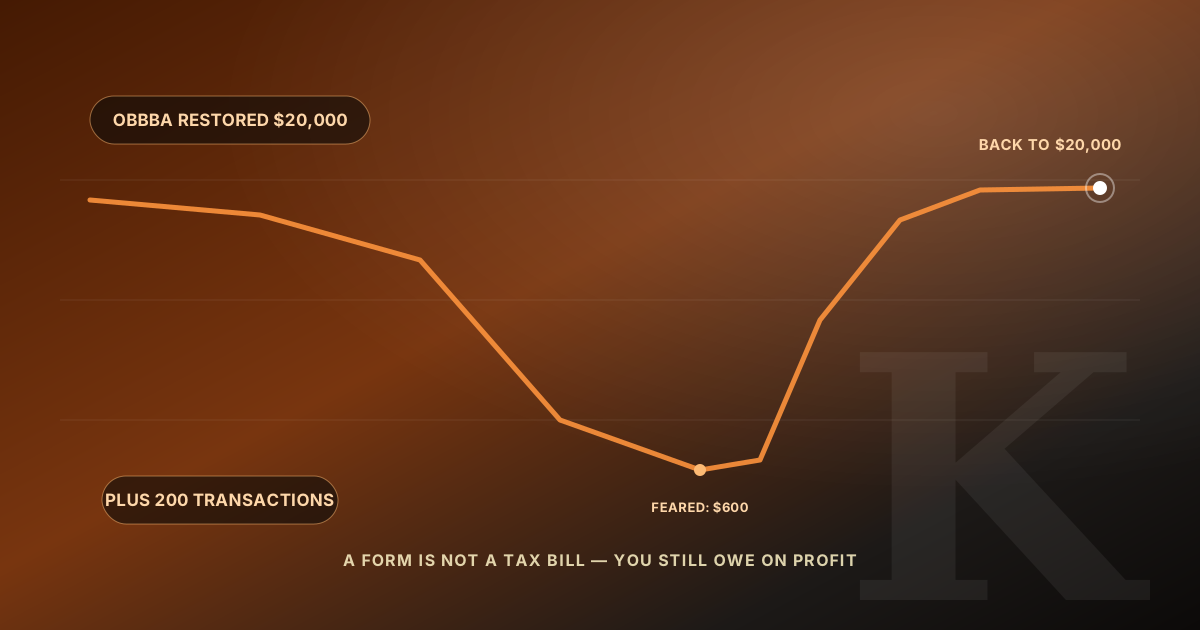
Here's the situation. For four years, resellers and freelancers heard a scary headline: the IRS was going to send you a 1099-K if you cleared just $600 through Venmo or PayPal. Then the One Big Beautiful Bill Act (OBBBA), signed July 4, 2025, retroactively wiped that out and restored the old threshold. I've dug through the IRS guidance, and this is what I wish someone had handed me the first year I sold things online.
Key Takeaways
The federal 1099-K threshold is back to more than $20,000 AND more than 200 transactions, both required, per platform.
This is retroactive to tax years beginning after December 31, 2021 — the $600 rule effectively never happened.
All income remains taxable whether or not you receive a form.
Payment-card transactions have no threshold — they're reportable from dollar one.
Separately, the 1099-NEC/1099-MISC threshold rose from $600 to $2,000 for 2026 payments.
What actually changed
The IRS revised its Form 1099-K FAQs in Fact Sheet 2025-8 on October 23, 2025 to reflect OBBBA. The bottom line: a third-party settlement organization (TPSO) — think PayPal, Venmo, eBay, Etsy, StubHub — is only required to file a Form 1099-K when your gross payments exceed $20,000 AND the number of transactions exceeds 200. Both conditions. On a single platform.
That $600-versus-$20,000 whiplash was real. The American Rescue Plan Act of 2021 dropped the threshold to $600; the IRS then delayed it repeatedly, announcing a $5,000 threshold for 2024 and a $2,500 threshold for 2025, with $600 due to hit in 2026. OBBBA erased all of it and put the pre-2022 rule back permanently.
The AND is the whole rule, and $100 is the pivot
Almost every write-up treats the two numbers as alternatives. They are not, and the consequence is not small. Because both lines must be crossed, the threshold is not a revenue line at all — it is a line in two dimensions, and which half binds depends entirely on your average sale price.
Divide one by the other and the pivot is exact: $20,000 / 200 = $100. Above a $100 average sale you hit the dollar figure long before the transaction count, so the count is what holds the form off. Below $100, the reverse. I computed the whole grid:
Average sale
Sales before a form
Revenue at that point
What binds
$10
2,001
$20,010
dollar amount
$50
401
$20,050
dollar amount
$100
201
$20,100
both at once
$250
201
$50,250
transaction count
$500
201
$100,500
transaction count
$2,000
201
$402,000
transaction count
Read the last row. A seller whose average sale is $2,000 can take $402,000 through a single platform before the reporting threshold is met, because 201 is the first count that clears "more than 200." Meanwhile a seller moving 201 items at $100 gets a form at $20,100.
Real money, no form
The corollary catches people out in both directions:
Sales
Average price
Revenue
Form issued?
12
$7,500
$90,000
no
50
$2,000
$100,000
no
200
$450
$90,000
no
900
$20
$18,000
no
Every row is a real seller with real income and no 1099-K. Which brings up the thing that matters more than any of this: the form is not the tax. All of that income is reportable whether or not a platform tells the IRS about it. If you have been treating "no form arrived" as "nothing to report," the restored threshold has just made that mistake considerably easier to make.
A form is not a tax bill
Here's where two numbers that look similar measure genuinely different things, and I want to flag it explicitly because this is where people overpay. The 1099-K reports gross payment volume — the full amount that flowed through the platform, before platform fees, shipping, sales tax collected, refunds, and returns. It is not your profit, and it is not what you're taxed on.
Warning
If a 1099-K shows $22,000, that is not $22,000 of taxable income. You report the gross figure on Schedule C, then subtract your cost of goods sold, platform fees, shipping, and other legitimate expenses. Your Line 31 net profit is what actually gets taxed — and what self-employment tax is calculated on.
There's also a distinction between a hobby and a business that changes everything about how you file. If you're a business (you're selling with the intent to make a profit), you file Schedule C and can deduct expenses. If it's a hobby, you report the income but generally can't deduct expenses against it. And if you're just selling personal stuff at a loss — the classic "cleaned out the garage" case — you generally don't owe tax on items sold for less than you paid, but you still have to be able to show that.
Scenario
Get a 1099-K?
Owe tax?
Sold 250 items totaling $12,000 on one platform
No (under $20,000)
Yes, on any profit
Sold one item for $25,000, 1 transaction
No (under 200 transactions)
Yes, on any profit
$30,000 across 400 transactions on one platform
Yes
Yes, on net profit
Any amount via credit-card processor
Yes (no threshold)
Yes, on net profit
Three traps in the fine print
Trap one: state thresholds are lower. The federal threshold does not preempt states. Several states set their own, much lower, reporting thresholds, so you may get a form from a platform even when you're nowhere near $20,000 federally.
Trap two: the threshold is per-platform. If you sell $15,000 on eBay and $15,000 on Etsy, neither issues a 1099-K, but you owe tax on the profit from all $30,000. The absence of a form is not the absence of a liability.
Trap three: card payments. If customers pay you by credit or debit card through a merchant processor, those are reportable from the first dollar. The $20,000/200 rule only shields third-party network transactions.
Pro Tip
Keep your own books regardless of what forms show up. Reconcile every 1099-K against your records — gross figures routinely look "too high" because they include money that was never yours to keep (sales tax, refunds, shipping you passed through).
Use the calculator to turn a scary gross number into the figure you'll actually be taxed on. Enter your gross platform payments, then your costs. It estimates net profit and a rough self-employment tax so you can set money aside.
This is an estimate, not tax advice. It simplifies the deductible half of SE tax and ignores the QBI deduction, credits, and state tax. Confirm with a professional before filing.
Here's What I'd Actually Do
Stop treating the form as the trigger. Decide today whether your selling is a business, a hobby, or personal-property cleanout, because that determines how you file — not whether a 1099-K lands in your inbox.
Open a separate account for the hustle. Even a free checking account. Clean records are the difference between deducting expenses confidently and guessing.
Reconcile every form to your own books. If a 1099-K's gross number is inflated by fees and refunds, you fix that on Schedule C — you don't ignore the form.
Set aside 25–30% of net profit for federal income tax plus the 15.3% self-employment tax. If this is real money, look at quarterly estimated payments.
Check your state's threshold — it's probably lower than $20,000, so expect forms sooner than the federal rule implies.
Frequently Asked Questions
Yes. Income from selling goods or services is taxable whether or not a form is issued. The threshold only governs when a platform must send paperwork — it never governed whether you owe tax.
Methodology
The rule, quoted. From the IRS: a platform must report "when the total amount of payments you receive for goods or services through the platform exceeds $20,000 in more than 200 transactions." Both conditions, joined by AND — which is the entire basis of everything above.
Verification. Three checks, any of which stops the run. At the $100 pivot both lines must be crossed by the same transaction, which is what makes it the pivot. The counterexample must hold: 50 sales at $2,000 is $100,000 of revenue and no form — if that ever reports as reportable, the AND has been implemented as an OR and every figure here is wrong. And below the pivot the dollar line must bind while above it the count must, which is the finding itself, asserted rather than assumed.
Limits. Measured per platform, so a seller across three marketplaces is measured three times and may cross on none while crossing easily in aggregate. The figures are gross payments before fees, refunds and shipping — not profit, not even net revenue. Platforms may issue a form below the threshold and several do. And receiving no form changes nothing about what is owed.

 Sujit Karki|||8 min read