AI Didn't Kill the Entry-Level Job — But the Data Should Change Your First-Year Plan
Recent-grad unemployment is running well above the national rate. Here's what the data really shows about AI and entry-level work — and how to build income around it.
By most measures yes — recent-graduate unemployment (ages 22–27) has run around 5.6%, well above the ~4.2% national rate, and entry-level postings have fallen in several white-collar fields.
Get new posts in your inbox
No spam, unsubscribe anytime.
About the Author
Sujit KarkiFinance Researcher & Market Analyst
Independent finance researcher and market analyst with expertise in macroeconomics, equity markets, and personal finance. I help regular investors make better-informed decisions through rigorous, data-driven analysis.
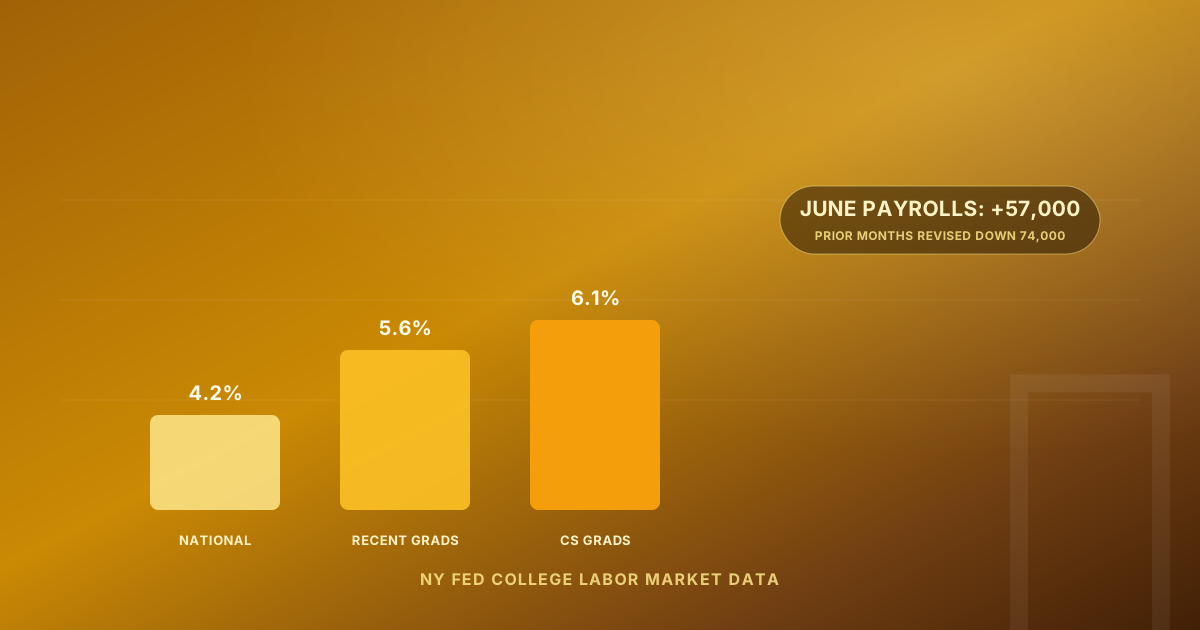
Recent-graduate unemployment (ages 22–27) has run around 5.6%, well above the roughly 4.2% national rate — an unusual and persistent gap.
There are TWO '5.6%' figures in this story that mean opposite things: recent-grad unemployment (bad) and NACE's projected increase in grad hiring (good). Don't conflate them.
Whether AI is the cause is genuinely contested — the EPI shows young non-college workers saw similar increases, which cuts against AI as the sole driver.
June 2026 payrolls rose just 57,000 and April–May were revised down a combined 74,000 — the labor market is cooling regardless of the AI debate.
The July jobs report is due out Friday, August 7 — worth checking against everything below once it lands.
I want to be careful with this one, because it's a topic where fear outruns the data in both directions. You've seen the headlines: AI is eating entry-level jobs, the class of 2026 is doomed, a degree is worthless now. Some of that is real. A lot of it is overstated. Let me separate what the numbers actually say from what the narrative wants them to say — and then get practical about income.
The numbers that matter
Start with the hard labor-market data. The June 2026 jobs report showed nonfarm payrolls rising just 57,000 — well below the ~115,000 economists expected — and the prior two months were revised down by a combined 74,000. The unemployment rate actually dipped to 4.2%, but partly because people left the labor force; participation fell to 61.5%.
Underneath that cooling overall market, young graduates are having a distinctly harder time. The Federal Reserve Bank of New York's college labor-market data has shown recent-graduate unemployment (ages 22–27) running around 5.6% — meaningfully above the national rate. Computer science graduates, of all fields, have been among the worst hit, at 6.1% (with computer engineering higher still, at 7.5%).
Two "5.6%" numbers that mean opposite things
Here's the kind of thing that drives me a little crazy, and it's exactly why you can't skim these stories. There are two different 5.6% figures floating around this topic, and they point in opposite directions:
Recent-grad unemployment ≈ 5.6% (NY Fed) — this is bad: more young grads out of work.
NACE's Job Outlook 2026 Spring Update projected employers would hire 5.6% more Class of 2026 grads than the prior class — this is good, and it was an upgrade from a roughly flat (1.6%) projection in the fall.
Same number, opposite meaning, different sources measuring completely different things. If you see "5.6%" in a headline about the grad market, check which one it is. (You'll also see recent-grad unemployment quoted as 5.7% in some late-2025 data — again, different period, not a contradiction.)
Note
The NACE and NY Fed figures don't actually conflict. Employers can plan to hire more grads (NACE) while the pool of unemployed recent grads stays elevated (NY Fed), especially since NACE's hiring gains were concentrated at the largest firms (those over 5,000 employees projected 8.7% growth).
Is it actually AI?
This is where I'll push back on the dominant story. The claim is that AI is automating the "grunt work" — data entry, basic coding, junior analysis — that used to be the on-ramp for new hires. There's real anecdote and some data behind it, and per NACE, 35% of entry-level jobs now require AI skills.
But the Economic Policy Institute made a point I find persuasive: young non-college workers experienced similar increases in unemployment over the same period. If AI were uniquely destroying college-graduate entry-level jobs, you'd expect the college group to diverge sharply from the non-college group. They largely didn't. That suggests a good chunk of what we're seeing is a broadly cooling labor market — the same slowdown showing up in that 57,000 payroll print — not a clean AI-specific effect.
I'm not saying AI has no impact. I'm saying the honest answer is "cooling labor market plus some AI displacement, in proportions nobody can cleanly measure yet." Plan for both.
Building income around a weak first rung
If the first rung of the ladder is wobbly, the response isn't panic — it's diversifying how you earn and how you signal skills. A side hustle in 2026 does two jobs for a young worker: it bridges income, and it produces concrete, applied work that answers the exact thing employers now demand — "can you do higher-value work from day one?"
There's also an expectations gap worth naming. A Clever survey found current students expect to earn $80,004 on average one year after graduation, while Census data puts actual pay for full-time degree-holders ages 18–25 at $56,153. If you anchor to the first number, a fair offer will feel like an insult — and you may pass on a role that would actually build your skills.
Pros
Bridges income during a longer job search
Produces a portfolio of applied, AI-adjacent work
Builds skills employers say they can't find
Flexible around interviews and part-time roles
Cons
Self-employment income is taxed differently — plan for it
Easy to mistake activity for progress
Doesn't replace benefits or a stable salary
Income is lumpy and unpredictable early on
Interactive · bridge your own gap
How much side income would close your income gap?
Target starting salary$56,153
Actual salary (or $0 if unemployed)$0
Months to bridge6
Self-employment tax reserve28%
Your annual gap is $56,153. Over 6 months, closing it takes about $6,499 a month in gross side income, after setting aside 28% for self-employment taxes.
Annual income gap
$0
Monthly gross side income needed
$0
Tax reserve applied
0%
Estimate only — not financial advice.
New grad income gap — data table
Target salary
$56,153
Actual salary
$0
Annual gap
$56,153
Bridge months
6
Tax reserve
28%
Monthly gross needed
$6,499
Estimate your income gap
The calculator above estimates the monthly side-income you'd need to bridge the gap between your target starting salary and a lower actual offer (or a period of unemployment), over a chosen number of months. It's an estimate, not financial advice.
Watch the July jobs report, out Friday, August 7 at 8:30 a.m. ET. One weak or strong print can shift this framing quickly — check it against the numbers above before drawing firm conclusions.
Treat "AI killed my job prospects" as a hypothesis, not a fact. The data shows a cooling market broadly, not a clean AI wipeout — plan for a tougher search, not a hopeless one.
Build one piece of applied, portfolio-ready work — a project, a shipped thing, a measurable result — that shows you can operate above pure "grunt work."
Start a small, skills-aligned side hustle to bridge income, and set aside roughly 25–30% of the profit for self-employment taxes so you're not blindsided.
Widen your target list to include public-sector, healthcare, and education roles, which have been more insulated from entry-level cuts.
Don't over-index on starting salary. Grads expect far more ($80,004) than actual starting pay ($56,153); a lower first offer that builds real skills beats waiting for a number that isn't coming.
Frequently Asked Questions
By most measures yes — recent-graduate unemployment (ages 22–27) has run around 5.6%, well above the ~4.2% national rate, and entry-level postings have fallen in several white-collar fields.
This is educational content, not financial or career advice. I'm a researcher, not your advisor, and labor-market data updates monthly. Check the latest BLS and NY Fed releases before making decisions about your job search. See the full disclaimer.

 Sujit Karki||5 min read